
What's Happening?
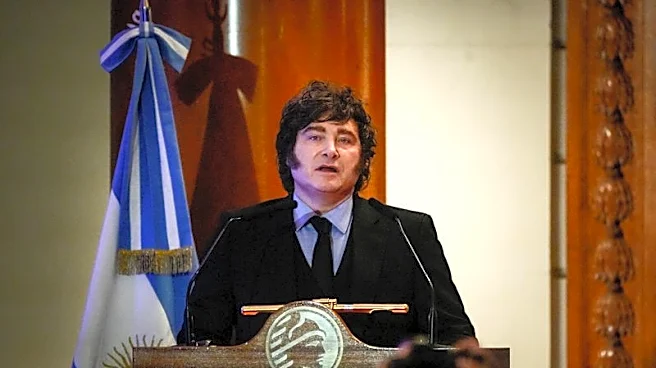
President Trump recently posted on social media, suggesting a name change for New Mexico to 'New America' and claiming the state was 'one of the greatest vote cheating states of all time.' This action
follows previous instances where President Trump has used social media to provoke and mock perceived political adversaries, including suggesting Canada become the 51st state and renaming the Gulf of Mexico and Lake Ontario to 'Gulf of America' and 'Lake America,' respectively. New Mexico's political leaders swiftly condemned President Trump's remarks. Governor Michelle Lujan Grisham stated that New Mexico's name is not up for debate, emphasizing its historical significance and criticizing President Trump for attempting to distract from issues like the war in Iran, rising gas prices, and inflation. U.S. Representatives Gabe Vasquez and Melanie Stansbury also voiced strong opposition, highlighting the state's rich history, culture, and identity.
Why It's Important?
President Trump's social media posts regarding New Mexico are significant as they highlight the ongoing political polarization and the use of social media as a tool for political commentary and provocation. The suggestion of renaming a state and making unsubstantiated claims about election integrity can undermine public trust in democratic processes and institutions. For New Mexico, the comments are seen as an attack on its identity, history, and sovereignty, prompting a unified response from state leaders across the political spectrum. This incident also draws attention to the broader implications of presidential rhetoric on state-federal relations and the potential for such statements to divert public attention from pressing national and international issues, as suggested by Governor Lujan Grisham. The strong reactions from New Mexico officials underscore the importance of state identity and the sensitivity surrounding historical and cultural heritage.
What's Next?
In the immediate future, it is likely that New Mexico's political leaders will continue to push back against President Trump's comments, reinforcing the state's identity and history. The incident may also become a talking point in upcoming political campaigns, particularly for U.S. Representative Gabe Vasquez, who is in a tight congressional race. The broader implications of President Trump's social media usage and its impact on political discourse will likely remain a subject of public debate. While no formal action is expected regarding the proposed name change, the event serves as a reminder of the power of presidential rhetoric and its potential to shape public perception and political narratives. The focus will likely shift back to the substantive issues that Governor Lujan Grisham mentioned, such as economic concerns and foreign policy.
Beyond the Headlines
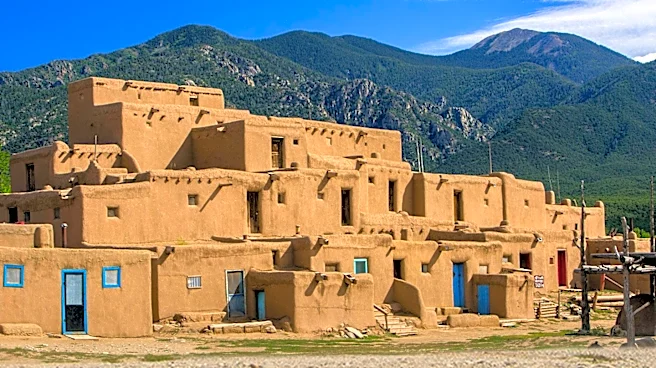
Beyond the immediate political reactions, President Trump's comments touch upon deeper themes of national identity, historical understanding, and the role of social media in modern politics. The name 'Nuevo México' dates back to the 16th century, predating the United States, and is intrinsically linked to Spanish colonial history, Mexican independence, and the subsequent integration into the U.S. The suggestion to rename it 'New America' can be interpreted as an attempt to erase or diminish this rich, multicultural heritage. This incident also highlights the ongoing challenge of combating misinformation and unsubstantiated claims, particularly regarding election integrity, which can erode democratic norms. The use of social media by high-profile political figures to make such statements raises ethical questions about accountability and the impact on public discourse, potentially fostering division and distrust rather than constructive dialogue.