




What's Happening?
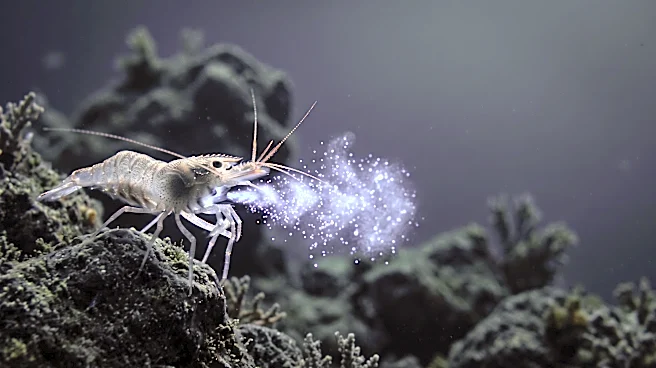
Antarctic krill, a foundational species in the Southern Ocean food web, have been discovered inhabiting deep-sea hydrothermal vents. This surprising finding was made during the National Geographic and Rolex Perpetual Planet Southern Ocean Expedition,
where researchers observed and collected egg-laden female krill at a vent off the Antarctic Peninsula. Kim Bernard, a biological oceanographer at Oregon State University, noted that krill had never before been spotted in such an extreme environment. Traditionally, krill are known to swarm in the upper layers of the ocean. The discovery suggests a previously unknown adaptive behavior, as these vents are characterized by extremely hot water, heavy metals, and a lack of sunlight, a stark contrast to their usual habitat.
Why It's Important?
This discovery is significant because it challenges existing understanding of Antarctic krill ecology and potentially highlights a new dimension of resilience for this crucial species. Krill are vital for the survival of penguins, seals, and whales, and their populations are increasingly threatened by climate change, which is rapidly warming the Southern Ocean. The ability of krill to utilize deep-sea hydrothermal vents, possibly for reproduction or access to scarce nutrients like manganese, could offer a buffer against environmental changes in surface waters. Understanding this new habitat may be critical for conservation efforts, especially if these vents serve as important refugia or breeding grounds. It also opens new avenues for research into deep-sea ecosystems and their potential roles in supporting broader marine life.
What's Next?
Scientists are now focused on understanding why krill are utilizing these deep-sea hydrothermal vents. Research will investigate the specific benefits krill derive from this environment, such as warmer waters for embryo development or access to unique microbial food sources and essential minerals like manganese, which is scarce in the Southern Ocean. Further expeditions are planned to explore other hydrothermal vents, as a subsequent discovery of egg-laden krill at another vent 1,000 miles away suggests this phenomenon is not isolated. The findings could inform new conservation strategies, potentially leading to the designation of marine protected areas around these vents if they prove critical for krill reproduction and survival, especially in the face of ongoing climate change impacts.
Beyond the Headlines
The presence of Antarctic krill in deep-sea hydrothermal vents offers a profound insight into the adaptability of life in extreme environments and the interconnectedness of marine ecosystems. This discovery pushes the boundaries of what is known about species distribution and survival mechanisms, suggesting that even well-studied organisms may harbor hidden ecological complexities. It also raises ethical and policy questions regarding the protection of deep-sea environments, which are often considered remote from human impact but may play unforeseen roles in global ecological balance. The research underscores the urgent need for comprehensive exploration and understanding of the deep ocean, particularly as climate change continues to alter more accessible marine habitats, potentially driving species to seek refuge in unexpected places.