


What's Happening?
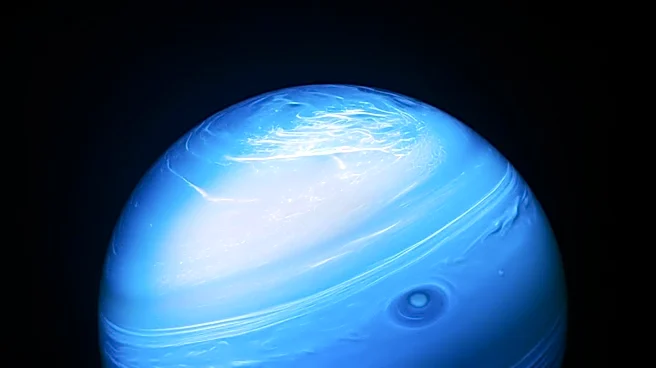
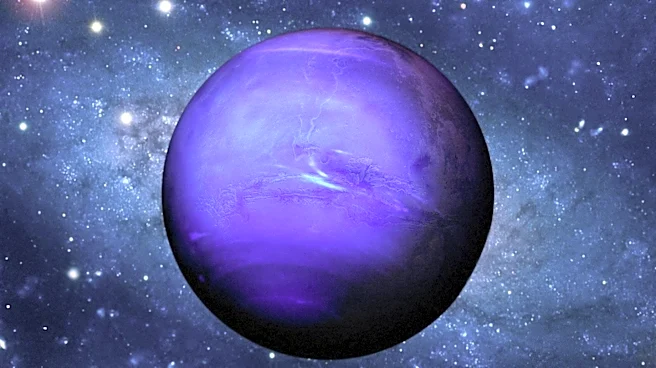
A new model developed by researchers led by Olivier Mousis at Southwest Research Institute suggests that atmospheric argon-40 could provide clues to the rocky interiors of Uranus and Neptune. The study, published in The Planetary Science Journal, explores
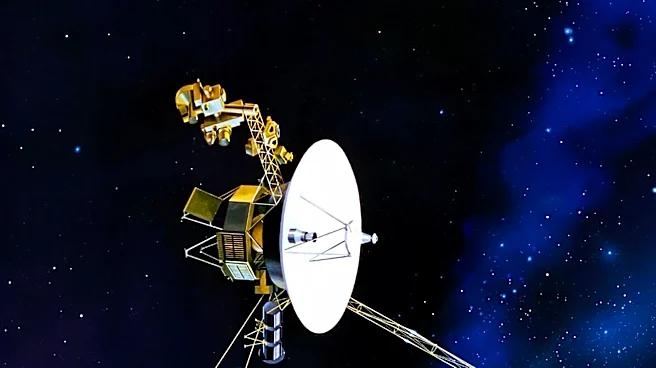
how argon-40, which can originate from the planets' building blocks or from the decay of radioactive potassium in their rocky cores, might be measured by future probes. The research indicates that under certain formation conditions, inherited argon-40 could mask the signal from rock-produced argon, complicating the understanding of the planets' internal composition. The model predicts what a future probe might find, emphasizing the need for comprehensive measurements of various gases to interpret the planets' histories accurately. Currently, only remote observations of Uranus' auroras are available, with Voyager 2 providing the only close spacecraft views of both planets in the late 1980s. A descent probe equipped with a mass spectrometer could directly collect and analyze atmospheric gases to distinguish isotopes.
Why It's Important?
Understanding the chemical origins and internal compositions of Uranus and Neptune is crucial for refining models of solar system formation. The 'ice giant' label for these planets leaves their proportions of rock and ice open to debate. If inherited argon-40 significantly influences atmospheric readings, it could lead to misinterpretations about the amount of rock buried deep within these planets. This research highlights the complexity of using atmospheric data to infer deep-seated planetary characteristics and underscores the importance of advanced instrumentation for future space missions. Accurate data on these planets could help scientists determine if they assembled from similar materials or if their formation processes differed, potentially revealing new insights into the early solar nebula and the conditions that shaped the outer solar system. The findings could influence the design and objectives of future planetary probes, such as the proposed Uranus Orbiter and Probe.
What's Next?
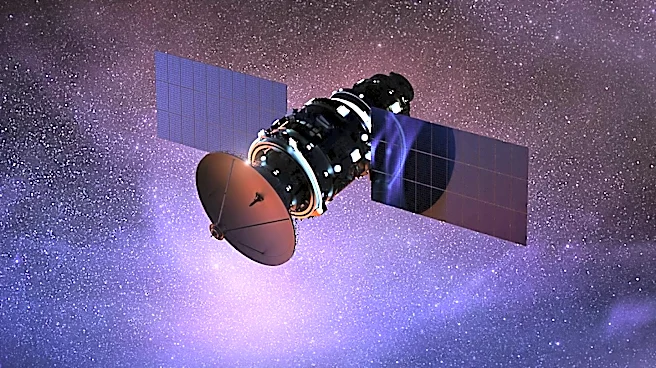
Future space missions, particularly those involving descent probes, are critical for validating the model's predictions. A proposed Uranus Orbiter and Probe concept, identified as a high priority by the 2023 to 2032 planetary science decadal survey, could provide the necessary data. Such a probe would collect gas directly and use a mass spectrometer to distinguish isotopes, offering a more direct view of the planets' histories. Comparable measurements from both Uranus and Neptune would allow researchers to determine if similar processes left comparable chemical signatures. Additionally, further studies on volatile compounds in smaller bodies and continued analysis of carbon and oxygen ratios will contribute to a more complete understanding of the ice giants' formation and evolution. The development of more sensitive instruments, building on lessons from missions like Jupiter's Galileo probe, will be essential for accurately measuring trace gases like argon-40.
Beyond the Headlines
The debate over the chemical origins of Uranus and Neptune extends beyond their individual compositions, touching upon fundamental questions about planetary migration and the dynamics of the early solar system. If Neptune's chemistry suggests it formed closer to the Sun and then migrated outward, as some models propose, it would challenge current assumptions about the stability of planetary orbits during formation. The ability to differentiate between inherited gases and those produced by radioactive decay within a planet's interior offers a powerful tool for 'geological' studies of distant worlds, even without direct access to their cores. This research also highlights the iterative nature of scientific discovery, where models guide observations, and observations refine models, continually pushing the boundaries of our understanding of the cosmos. The ethical implications of space exploration, particularly regarding the preservation of potential extraterrestrial environments, also come into play as probes are designed to interact directly with planetary atmospheres.