






What's Happening?
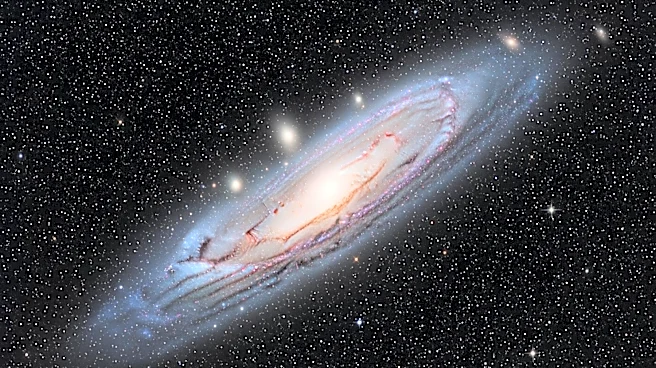
A team of researchers from the University of Malta has identified the edge of the Milky Way galaxy, marking a significant milestone in understanding its structure. By analyzing data from over 100,000 giant stars using surveys like APOGEE-DR17, Gaia, and LAMOST-DR3,
they determined that the galaxy's outermost star-forming region is approximately 40,000 light-years from the center. This discovery highlights a U-shaped pattern in stellar ages, where stars are younger at greater distances from the center until a certain point, beyond which they become older again. This pattern is common in other Type II galaxies and suggests that many stars in the outer disk originally formed closer to the center and migrated outward.
Why It's Important?
This discovery is crucial for understanding the Milky Way's formation and evolution. The identification of the galaxy's edge provides insights into the processes that govern star formation and migration. The findings suggest that the Milky Way's structure is influenced by gravitational instabilities and the central stellar bar, which may drive the migration of stars from the inner to the outer disk. Understanding these dynamics is essential for astrophysics, as it helps refine models of galaxy formation and the distribution of stellar ages and compositions. This research also contributes to the broader field of galactic archaeology, offering a clearer picture of how galaxies like the Milky Way grow and change over time.
What's Next?
Future research will likely focus on further refining the understanding of the Milky Way's structure and the mechanisms driving star migration. Additional surveys and observations, such as those from upcoming missions like 4MOST and WEAVE, will provide more detailed data to enhance these findings. Researchers will continue to explore the role of the central bar and other factors in shaping the galaxy's structure. This ongoing research will help astronomers develop more accurate models of the Milky Way and other similar galaxies, contributing to a deeper understanding of the universe's evolution.