
What's Happening?
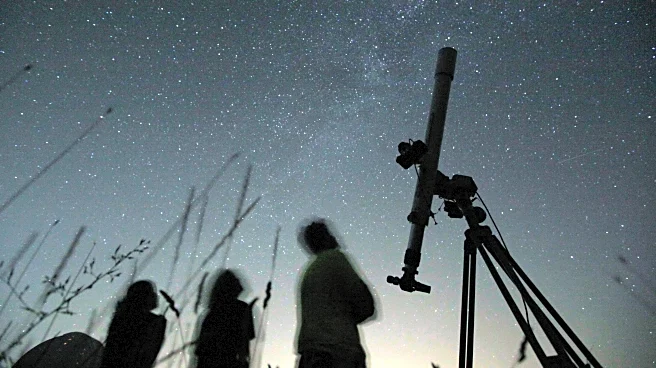
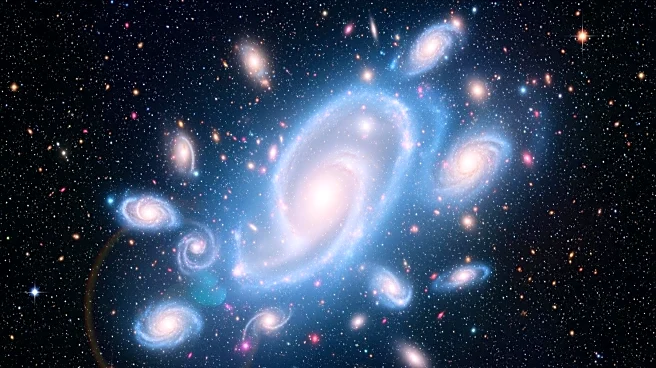
Astronomy enthusiasts are encouraged to observe the Coma Cluster of galaxies, a massive conglomeration located approximately 330 million light-years away. Known as Abell 1656, this cluster contains thousands of galaxies and is best viewed with large telescopes
of 12 inches or more. The cluster's core, which spans about half a degree in the sky, can be located by first pointing a telescope at magnitude 4.2 Beta Comae Berenices and then moving just under 3° west. The brightest galaxies in the cluster include NGC 4889, NGC 4793, and NGC 4874, with NGC 4889 being a large elliptical galaxy. This observation opportunity is part of a series of celestial events highlighted by Astronomy Magazine.
Why It's Important?
The Coma Cluster offers a unique opportunity for astronomers and hobbyists to study a dense collection of galaxies, providing insights into the structure and evolution of the universe. Observing such clusters helps in understanding galaxy formation and the distribution of dark matter. The event also promotes public interest in astronomy, encouraging the use of telescopes and other observational tools to explore deep-sky objects. This aligns with broader educational goals to increase scientific literacy and appreciation for space science.