
What's Happening?
The state of Tennessee has issued the first license for a commercial nuclear fusion project in the U.S. under a new regulatory framework designed to accelerate the technology's development. Knoxville-based
Type One Energy plans to commence construction this year on 'Project Infinity,' a prototype fusion reactor. This facility will be located at the Tennessee Valley Authority's (TVA) former Bull Run coal-fired power plant in Anderson County. Unlike traditional nuclear fission, which splits uranium atoms, Type One Energy's reactor will generate energy by fusing hydrogen isotopes at extremely high temperatures. The company's ultimate goal is to establish the world's first commercial nuclear fusion power plant, with a target of fully activating its initial reactor by 2034. This initiative is supported by a $4.5 million grant from Tennessee's nuclear fund, established by Governor Bill Lee and authorized by the General Assembly, which has since grown to $95 million.
Why It's Important?
This licensing marks a significant step in the U.S. pursuit of commercial nuclear fusion, positioning Tennessee as a leader in advanced nuclear energy innovation. The development of a clear regulatory pathway for fusion energy could serve as a model for other states, potentially accelerating the deployment of this technology nationwide. Commercial nuclear fusion promises a clean, abundant, and reliable energy source, which could drastically reduce reliance on fossil fuels and address climate change concerns. For the U.S. energy sector, successful commercialization of fusion could enhance grid stability and energy independence. The collaboration between Type One Energy and TVA, including access to TVA's Power Service Shops and potential early access to commercial electricity, highlights a strategic partnership that could benefit both the private sector and public utilities. This project also represents a potential economic boost for Tennessee, fostering job creation and technological advancement in the region.
What's Next?
Type One Energy is scheduled to break ground on Project Infinity this year. Following the prototype, the company plans to develop a pilot fusion power plant named Infinity Two. The aim is to have the first reactor fully operational by 2034. The Bull Run site is envisioned to evolve into a fusion development campus, leveraging partnerships with Oak Ridge National Laboratory, TVA, and the University of Tennessee. The success of this project could pave the way for further investment and development in nuclear fusion technology across the U.S. Other states and companies will likely observe Tennessee's regulatory framework and Type One Energy's progress as they consider their own approaches to commercializing fusion energy. The U.S. Nuclear Regulatory Commission's delegation of fusion energy plant regulation to states suggests a decentralized approach to oversight, which could lead to varied regulatory environments across the country.
Beyond the Headlines
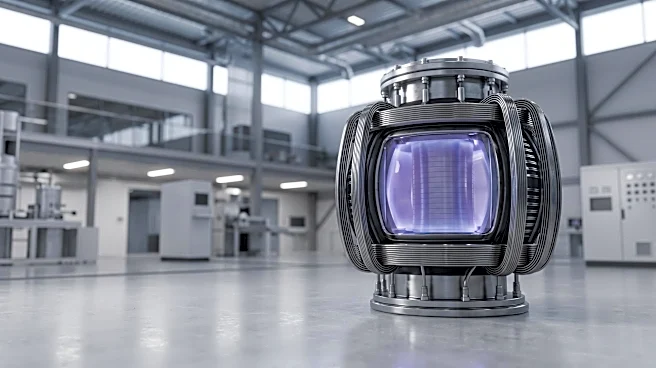
The issuance of this license underscores a broader shift in energy policy and technological ambition within the U.S., moving towards advanced and potentially transformative energy sources. The 'stellarator' technology, a twisted doughnut-shaped machine using magnetic fields to contain plasma heated to 180 million degrees, represents a cutting-edge scientific endeavor. While the process mimics the sun's energy generation, commercializing it has been a long-standing challenge. This development highlights the ethical and environmental considerations inherent in nuclear technology, even fusion, which is considered cleaner than fission. The regulatory framework's emphasis on 'safety by design' is crucial for public acceptance and long-term viability. The project also signifies a strategic repurposing of former coal-fired power plant sites, aligning with environmental goals and economic transition in regions historically dependent on fossil fuels. The long-term implications could include a fundamental reshaping of global energy markets and geopolitical dynamics.