




What's Happening?
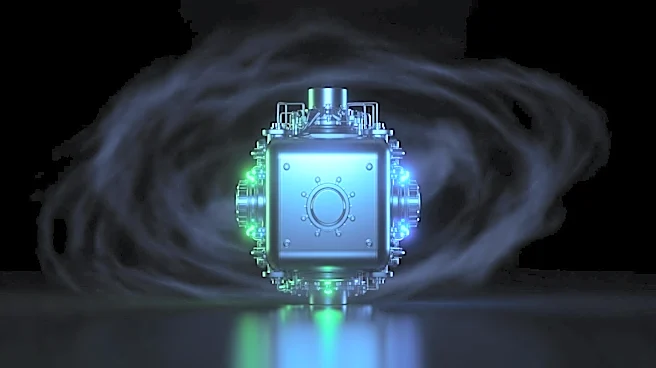
The CRESST experiment, a leading initiative in the search for dark matter, is advancing its capabilities to detect sub-GeV dark matter particles. The experiment utilizes scintillating crystals and cryogenic calorimeters to measure interactions that may
indicate the presence of dark matter. Recent developments in the CRESST-III phase have focused on reducing background noise, known as the Low Energy Excess (LEE), which has historically limited the experiment's sensitivity. By implementing improved module designs and advanced analysis strategies, the team aims to reduce the LEE by factors of 10 to 100. These enhancements are expected to significantly increase the experiment's sensitivity to light dark matter particles. The CRESST setup is also being upgraded to include more detectors, which will allow for a broader range of dark matter mass detection and improve the overall sensitivity of the experiment.
Why It's Important?
The advancements in the CRESST experiment are crucial for the field of particle physics and the ongoing search for dark matter, a mysterious component of the universe that has eluded direct detection. By improving the sensitivity of their detectors, the CRESST team is enhancing the potential to discover new particles that could provide insights into the fundamental nature of matter and the universe. This could have profound implications for our understanding of physics beyond the Standard Model. Additionally, the ability to detect lighter dark matter particles opens new avenues for research and could lead to breakthroughs in identifying the constituents of dark matter, which makes up a significant portion of the universe's mass.
What's Next?
The CRESST team plans to continue refining their detection methods and expanding their experimental setup. The next steps involve further reducing the LEE and increasing the number of detectors to enhance the experiment's sensitivity. These efforts are expected to yield more precise data and potentially lead to the first direct detection of dark matter particles. The team will also explore the potential for detecting other forms of dark matter, such as dark photons and axions, which could provide additional insights into the nature of dark matter. As the experiment progresses, the results will be closely monitored by the scientific community, with the potential to influence future research directions in particle physics.
Beyond the Headlines
The CRESST experiment's advancements highlight the importance of international collaboration and innovation in scientific research. The development of new technologies and methodologies in the search for dark matter not only advances our understanding of the universe but also drives technological progress in related fields. The experiment's success could inspire similar initiatives and foster a greater emphasis on fundamental research in physics. Additionally, the ethical considerations of scientific research, such as the responsible use of resources and the potential implications of new discoveries, remain an important aspect of the ongoing work in this field.