





What's Happening?
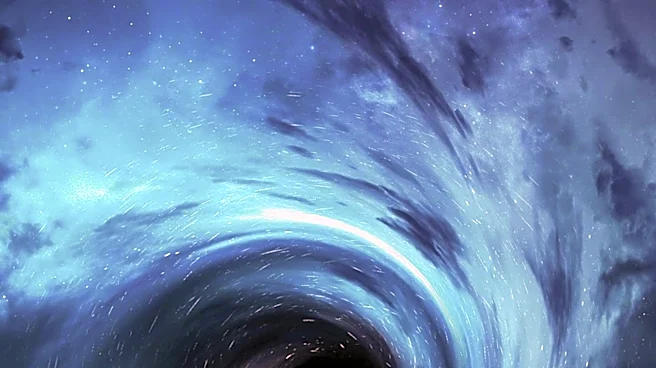
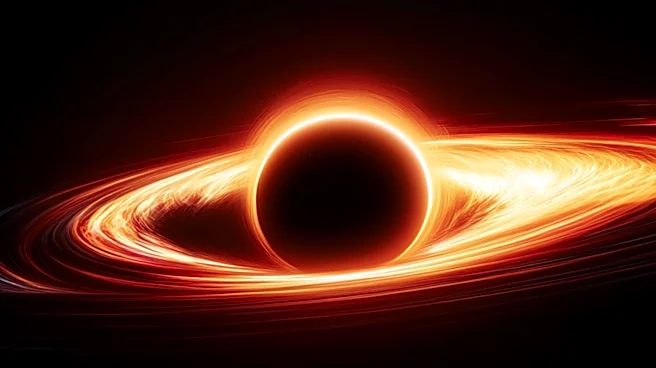
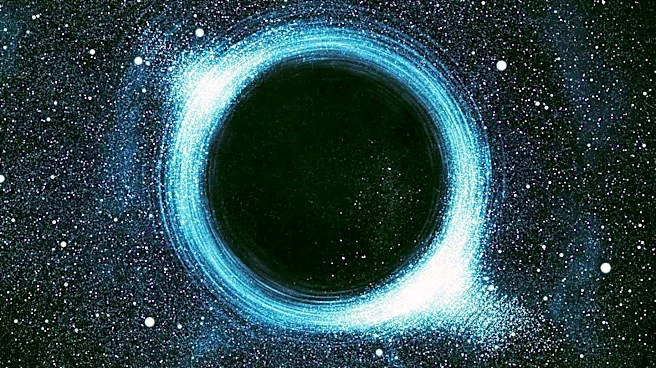
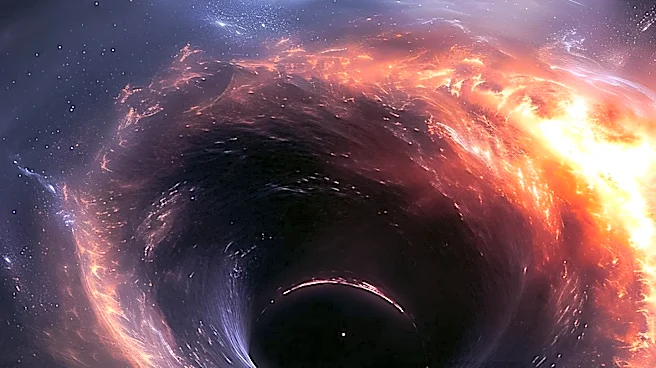
Recent research has revealed that merging black holes are not a uniform group but consist of distinct subpopulations. This discovery was made by two independent research teams who analyzed gravitational-wave data. The studies, published in Physical Review
Letters, indicate that these subpopulations are differentiated by their mass and spin properties. The research suggests that some black holes are second-generation merger remnants, rather than products of single stellar collapse. This finding is based on the analysis of gravitational waves, which encode information about the masses and spins of merging black holes. The studies highlight the presence of a group of black holes, each approximately 40 times the mass of the sun, with high, often misaligned spins.
Why It's Important?
The identification of distinct subpopulations of black holes has significant implications for our understanding of black hole formation and evolution. It challenges the traditional view that black holes form solely from the collapse of massive stars. Instead, it suggests that some black holes are the result of previous mergers. This insight could help explain the presence of black holes in mass ranges previously thought to be inaccessible and provide clues about the growth of supermassive black holes at the centers of galaxies. As gravitational-wave detectors become more sensitive, these findings could refine our understanding of black hole demographics and the dynamics of stellar environments.
What's Next?
As gravitational-wave detection technology advances, researchers anticipate that the boundaries between these subpopulations will become clearer. This could lead to a more detailed understanding of the formation mechanisms of black holes and their evolutionary pathways. Future studies may focus on refining models to better predict the characteristics of these subpopulations and explore the implications for the broader cosmic landscape. The continued analysis of gravitational-wave data will be crucial in uncovering further details about the origins and evolution of black holes.