
What's Happening?
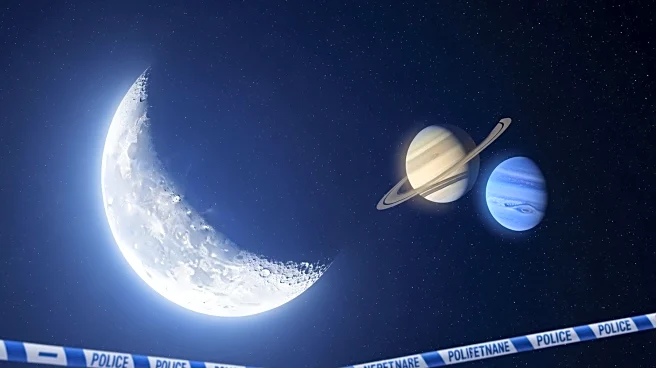
On January 23, 2026, the Moon will pass close to Saturn and Neptune, creating a rare triple conjunction visible in the evening sky. The event will be observable for several hours after sunset, with the celestial
bodies positioned in the southwestern sky. Saturn, easily visible to the naked eye, will appear below the crescent Moon, while Neptune, requiring binoculars or a telescope, will be located northeast of Saturn. This alignment offers a unique opportunity to view these distant worlds in close proximity, with Saturn's rings and its largest moon, Titan, visible through a telescope.
Why It's Important?
This conjunction provides a rare chance for both amateur and professional astronomers to observe and study the alignment of these celestial bodies. It highlights the dynamic nature of our solar system and offers educational opportunities for those interested in astronomy. The event can inspire public interest in space and science, potentially leading to increased engagement with astronomical societies and educational programs. For researchers, it presents an opportunity to gather data on the positions and movements of these planets, contributing to a deeper understanding of their orbits and interactions.
What's Next?
Following this event, astronomers and enthusiasts can anticipate other significant celestial events throughout the year. The interest generated by this conjunction may lead to increased participation in astronomy-related activities and events. Educational institutions and observatories might organize workshops and viewing sessions to capitalize on the public's interest. Additionally, this event could inspire further research into planetary alignments and their implications for our understanding of the solar system.