





What's Happening?
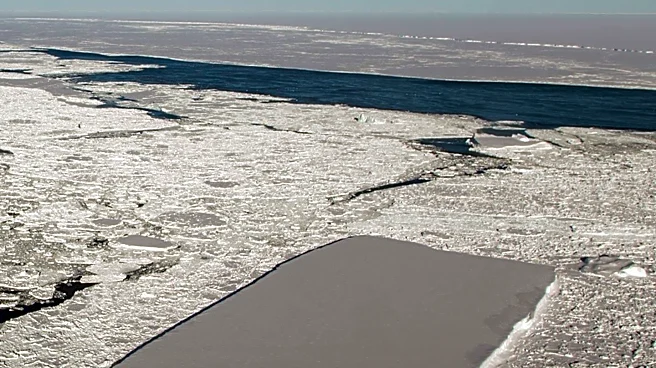
Scientists have uncovered a massive fan-shaped geological structure beneath Antarctica's ice sheet, known as the East Antarctic Fan-Shaped Basin Province (EAFBP). This discovery, published in Nature Geoscience, reveals a continent-scale system that connects
previously separate underground basins. The structure is believed to have formed through a process called distributed rotational extension, where the continental crust stretches outward from a central point, creating wedge-shaped basins. This finding reshapes the understanding of the breakup of the ancient supercontinent Gondwana and suggests that East Antarctica's crust experienced more intense deformation than previously thought.
Why It's Important?
The discovery of the EAFBP has significant implications for understanding Antarctica's geological history and its current ice dynamics. The structure influences how ice moves across the continent, affecting glacier flow and ice stream behavior. This information is crucial for modeling how Antarctica's ice sheet might respond to rising temperatures, which directly impacts global sea-level projections. Additionally, the finding challenges the perception of East Antarctica as a geologically stable region, revealing a more complex history of crustal deformation that could have facilitated the breakup of Gondwana.
What's Next?
Further research is needed to determine the precise timeline and forces that led to the formation of the EAFBP. Scientists will likely conduct more detailed seismic surveys and refined geological modeling to fill in these gaps. Understanding the structure's formation will enhance predictions of how Antarctica's ice sheet will behave in a warming climate, providing valuable insights for global sea-level rise projections.
Beyond the Headlines
The discovery of the EAFBP highlights the hidden complexities of Antarctica's geological past and its ongoing influence on ice dynamics. It underscores the importance of continued exploration and research in remote regions to uncover Earth's ancient history and inform future climate models. This finding serves as a reminder that even well-studied areas like Antarctica can hold significant secrets beneath their surfaces.