



What's Happening?
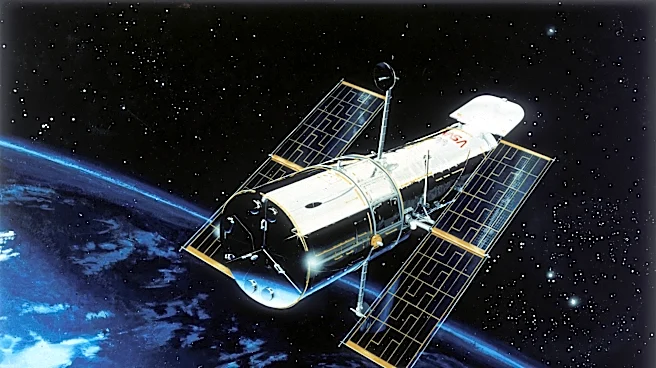
NASA has issued a formal Request for Information (RFI) to solicit proposals from the private sector for in-space servicing of the Hubble Space Telescope. The telescope, a national icon responsible for groundbreaking discoveries over 30 years, is gradually
descending due to atmospheric drag and lacks a propulsion system to adjust its orbit. Without intervention, NASA estimates Hubble will re-enter Earth's atmosphere between 2033 and 2034. The agency is primarily interested in proposals to raise Hubble's altitude to extend its operational lifespan, but is also open to suggestions for managing a safe and controlled reentry or disposal, as well as potential upgrades to enhance its functionality. This initiative follows a non-funding partnership agreement with SpaceX in September 2022 to investigate using a Dragon spacecraft for a similar purpose, though that study was solely to assess commercial feasibility.
Why It's Important?
The Hubble Space Telescope has been instrumental in transforming humanity's understanding of the universe, making its continued operation highly valuable to the scientific community. Extending Hubble's life would allow for more discoveries and scientific advancements, benefiting astronomical research and potentially inspiring future generations. From a financial perspective, exploring cost-effective ways to extend the life of an existing asset in orbit is a responsible approach to taxpayer money. The involvement of the private sector in such a critical mission highlights a growing trend of collaboration between government agencies and commercial space companies, potentially fostering innovation and new capabilities in in-space servicing. The loss of Hubble would represent a significant setback for observational astronomy, making efforts to prolong its mission crucial for ongoing scientific exploration.
What's Next?
NASA will evaluate the proposals received from the private sector in response to its Request for Information. The agency aims to identify innovative and cost-effective solutions to either boost Hubble to a higher, more stable orbit, manage its safe reentry, or enhance its capabilities. A mission to raise the telescope's orbit would ideally need to be carried out by 2032 to prevent its anticipated re-entry. If a viable solution is found and implemented, the Hubble Space Telescope could continue to observe the cosmos for several more years, providing invaluable data. This process will likely involve further collaboration and potential contracts with commercial space companies, marking a significant step in leveraging private industry for critical space infrastructure maintenance.
Beyond the Headlines
The effort to save the Hubble Space Telescope underscores the increasing reliance on commercial space capabilities for missions traditionally handled by government agencies. This shift could lead to a more dynamic and competitive space industry, driving down costs and accelerating technological advancements in areas like in-orbit servicing and debris management. Ethically, the decision to extend Hubble's life versus investing in new flagship missions involves a balance between maximizing existing assets and pushing the boundaries of future exploration. The potential for a controlled reentry also highlights the growing concern about space debris and the need for responsible end-of-life planning for satellites. Ultimately, the success of this initiative could set a precedent for how valuable, aging space assets are managed in the future, influencing long-term space policy and international cooperation.