








What's Happening?
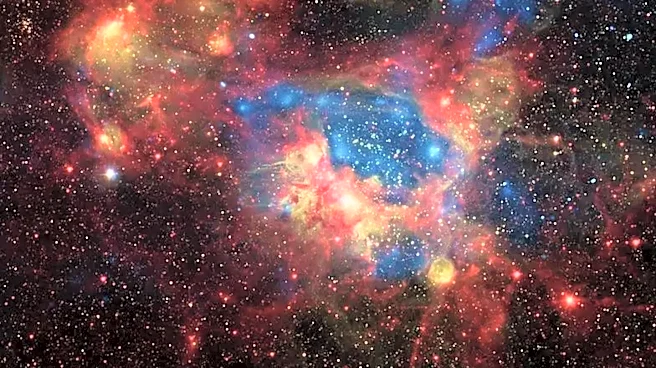
Astronomers have detected a true sugar molecule, erythrulose, in interstellar space for the first time. This discovery was made in a molecular cloud near the center of the Milky Way, about 27,000 light-years from Earth. Erythrulose is a four-carbon monosaccharide,
similar to sugars that form RNA and DNA. The finding suggests that complex organic molecules, essential for prebiotic chemistry, can form in space before planets exist. This discovery supports the idea that the building blocks of life could have originated in space and been delivered to Earth via asteroids and comets.
Why It's Important?
The detection of a sugar molecule in interstellar space is a significant step in understanding the origins of life. It provides evidence that complex organic compounds can form in space, potentially contributing to the development of life on planets. This finding supports theories that life's building blocks may have been delivered to Earth from space, influencing the study of astrobiology and the search for extraterrestrial life. The research also highlights the potential for discovering more complex molecules in space, advancing our understanding of chemical processes in the universe.
What's Next?
Researchers aim to identify larger sugar molecules, such as ribose, in interstellar space, which would bring them closer to understanding the origins of RNA and DNA. Future studies will focus on exploring molecular clouds and other regions of space to uncover additional organic compounds. These efforts could provide further insights into the chemical processes that lead to the formation of life, informing the search for life beyond Earth and the study of astrobiology.