
What's Happening?
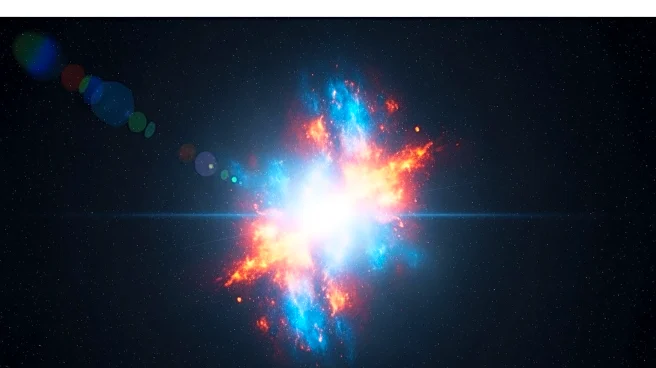
The James Webb Space Telescope (JWST) has detected a supernova at a redshift of approximately 7.3, corresponding to a time when the universe was about 730 million years old. This discovery, made by an
international team of astronomers, provides a direct look at the final moments of a massive star from the early universe. The supernova, associated with a gamma-ray burst (GRB 250314A), was initially detected by the space-based Variable Objects Monitor and later confirmed by the European Southern Observatory's Very Large Telescope. The findings challenge previous assumptions about stellar explosions in the early universe, suggesting that massive stars from that era may have exploded similarly to those today, despite lower metallicity conditions.
Why It's Important?
This discovery is significant as it provides a powerful anchor point for understanding stellar evolution in the early universe. The similarity of this distant supernova to those observed locally suggests that the physical conditions of early universe stars may not have led to markedly different stellar explosions. This challenges existing theories and opens new questions about the uniformity of stellar evolution across cosmic time. The findings could impact our understanding of the formation and evolution of the first stars and galaxies, offering insights into the conditions that prevailed in the early universe.
What's Next?
The research team plans to conduct a second epoch of JWST observations in the next one to two years. By then, the supernova's light is expected to have faded significantly, allowing for a more detailed characterization of the faint host galaxy and confirmation of the supernova's contribution. These future observations will help refine models of early universe stellar evolution and provide further insights into the nature of the first stars and galaxies.