
What's Happening?
Astronomy enthusiasts are encouraged to observe the Whale Galaxy (NGC 4631) in the constellation Canes Venatici, which is a prime target for deep-sky observation during the New Moon on May 16, 2026. The
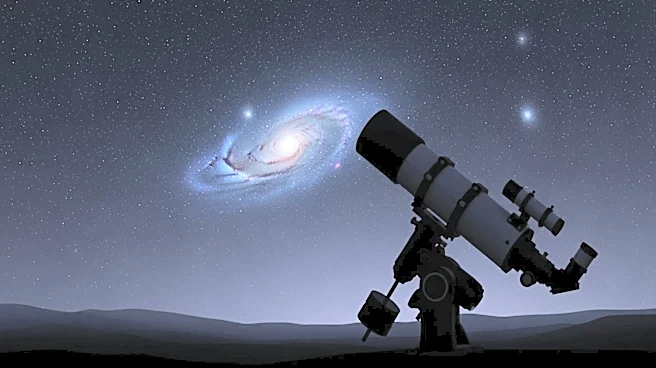
Whale Galaxy is an edge-on spiral galaxy, visible with an 8-inch or larger telescope at a magnification of 200x. It appears as a long, narrow structure with a mottled appearance due to dust lanes obscuring parts of its disk. The galaxy is located 6.5 degrees south-southwest of Cor Caroli, a bright star in the constellation. Nearby, the dwarf galaxy NGC 4627 can also be observed, which has historically interacted with the Whale Galaxy, leading to star formation.
Why It's Important?
The opportunity to observe the Whale Galaxy during a New Moon is significant for both amateur and professional astronomers, as the absence of moonlight enhances visibility of deep-sky objects. This event allows for detailed study of the galaxy's structure and its interaction with the nearby dwarf galaxy, contributing to the understanding of galactic formation and evolution. Such observations can inspire public interest in astronomy and encourage educational activities related to space science.
What's Next?
Following this observation opportunity, astronomers may continue to monitor the Whale Galaxy and its interactions with NGC 4627 to gather more data on star formation processes. Public interest generated by such events could lead to increased participation in astronomy clubs and educational programs, fostering a greater appreciation for space exploration and science.
Beyond the Headlines
The observation of the Whale Galaxy highlights the importance of dark sky preservation, as light pollution can significantly hinder astronomical observations. Efforts to reduce light pollution can enhance the ability to study celestial objects and promote environmental awareness. Additionally, such events underscore the value of amateur astronomers in contributing to scientific discoveries and data collection.