





What's Happening?
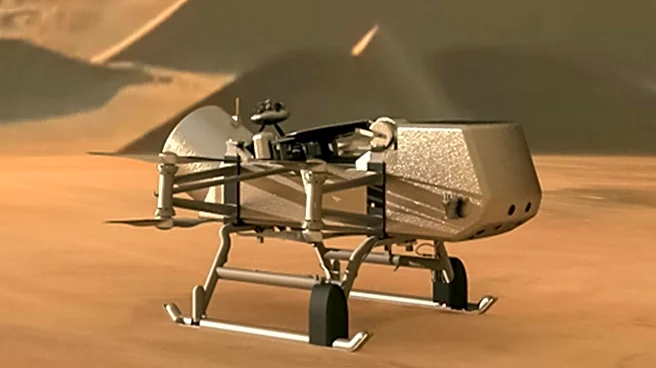
NASA is offering the public an opportunity to have their names sent to Titan, Saturn's largest moon, as part of the Dragonfly rotorcraft mission. Individuals who submit their names will receive a personalized boarding pass and have their names placed
on a microchip aboard the spacecraft. The Dragonfly mission is scheduled to launch in 2028 and will travel nearly a billion miles to reach Titan, with an expected arrival in 2034. The public has until January 15, 2027, at 11:59 p.m. EST to participate. Once on Titan, the rotorcraft will embark on a 3.3-year mission, flying across the moon's surface to investigate its chemistry and search for clues about the ingredients that may have contributed to the development of life. Titan is known for its rivers, lakes, changing seasons, and a landscape rich in organic material.
Why It's Important?
This initiative by NASA is significant as it fosters public engagement in space exploration and scientific discovery. By allowing individuals to symbolically participate in a deep-space mission, it can inspire interest in STEM fields and enhance public understanding of planetary science. The Dragonfly mission itself is crucial for astrobiology, as it will explore Titan's unique environment, which is rich in organic compounds and liquid methane, offering insights into prebiotic chemistry. Understanding the conditions on Titan could provide valuable data on the potential for life beyond Earth, even if it's not directly searching for extant life. The mission's findings could reshape our understanding of planetary habitability and the origins of life in the universe.
What's Next?
Following the public submission period, which closes on January 15, 2027, NASA will finalize the list of names to be etched onto a chip for the Dragonfly rotorcraft. The spacecraft will then proceed with its launch preparations for 2028. After its launch, Dragonfly will undertake a multi-year journey to Titan, arriving in 2034. Upon arrival, the rotorcraft will begin its planned 3.3-year mission, conducting flights across Titan's surface, collecting samples, and analyzing its atmospheric and surface composition. Scientists will then analyze the data transmitted back to Earth to further our understanding of Titan's chemistry and its implications for astrobiology. The mission's progress and discoveries will likely be shared with the public through various NASA channels.
Beyond the Headlines
The 'Send Your Name to Titan' campaign extends beyond a simple public relations effort; it represents a broader strategy by NASA to democratize space exploration and make scientific endeavors more accessible and relatable to the general public. This type of engagement can cultivate a sense of shared ownership in humanity's quest for knowledge about the cosmos. Ethically, it reinforces the idea that space exploration is a collective human endeavor, transcending national boundaries. Culturally, it taps into the innate human desire for exploration and discovery, allowing individuals to feel a personal connection to a mission that could potentially unlock profound secrets about the universe and our place within it. Such initiatives can also serve as a powerful tool for science education, inspiring future generations of scientists and engineers.