



What's Happening?
The Global Mangrove Alliance (GMA) Policy Working Group has released two policy briefs aimed at strengthening mangrove conservation and restoration efforts. These publications come ahead of the 17th meeting of the Conference of the Parties to the Convention
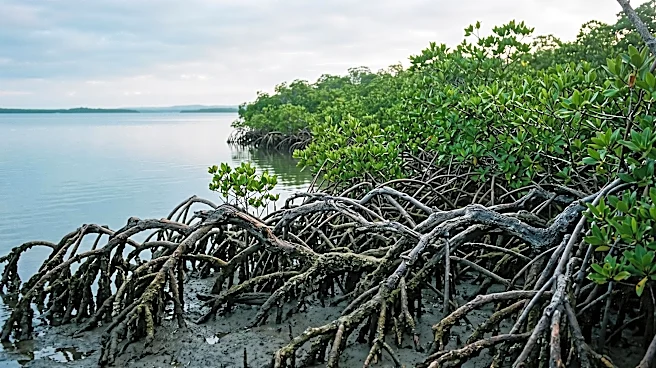
on Biological Diversity (CBD COP17). The briefs, titled 'Policy Coherence for Mangroves: Aligning Commitments across the Rio Conventions & Ramsar Convention on Wetlands' and 'Mangroves and CBD COP17: Entry Points and Recommendations,' outline strategies for governments and partners to enhance existing policy frameworks, improve monitoring and accountability, and mobilize investment for mangrove ecosystems. Mangroves are recognized for their critical role in supporting biodiversity, storing blue carbon, protecting coastal communities from climate impacts, and contributing to ecosystem resilience. The GMA emphasizes that stronger policy coordination can help countries achieve interconnected objectives more efficiently while increasing attention and investment in mangrove conservation and restoration.
Why It's Important?
These policy briefs are important because they highlight the urgent need for coordinated international action to protect and restore mangrove ecosystems, which are vital for both environmental health and human well-being. The reports underscore that current efforts to protect and restore coastal ecosystems, including mangroves, are lagging behind the 2030 targets of the Kunming-Montreal Global Biodiversity Framework (KMGBF). By advocating for stronger national implementation, cross-convention cooperation, improved monitoring, and increased finance, the GMA aims to translate global commitments into tangible actions. The recommendations could lead to more robust national frameworks, better alignment of international policies, and increased investment in nature-based solutions, ultimately benefiting coastal communities and global climate resilience. Failure to act could result in continued degradation of these critical ecosystems, exacerbating climate change impacts and biodiversity loss.
What's Next?
The GMA Policy Working Group encourages policymakers and partners participating in CBD COP17 and related international processes to utilize these recommendations. COP17 will serve as a crucial moment to assess progress on the KMGBF's 2030 targets, identify implementation gaps, and inform future actions. The briefs suggest that countries should embed mangrove commitments into durable national frameworks, supported by clear institutional mandates and multi-stakeholder coordination. Furthermore, there is a call to advance cross-convention cooperation by using COP17 agenda items to improve alignment across the KMGBF, UNFCCC, and Ramsar Convention on Wetlands. Improved monitoring and accountability, drawing on updated GMA technical resources and data, are also key next steps. Connecting commitments with finance by aligning mangrove investment priorities with National Biodiversity Strategies and Action Plans (NBSAPs) will be essential for successful implementation.
Beyond the Headlines
The deeper implications of these policy briefs extend to the ethical and long-term shifts in how global environmental governance addresses interconnected challenges. The emphasis on 'policy coherence' across multiple international conventions (Rio Conventions and Ramsar Convention) signifies a growing recognition that environmental issues cannot be tackled in isolation. This integrated approach acknowledges the complex interplay between biodiversity loss, climate change, and wetland degradation. The call for embedding mangrove commitments into national legal frameworks and cross-ministerial mandates suggests a shift towards more holistic and sustained environmental governance, moving beyond mere target-setting to concrete, institutionalized action. This could trigger a broader re-evaluation of how countries integrate environmental considerations into their national development strategies, fostering a more resilient and sustainable future for coastal regions and the planet.