



What's Happening?
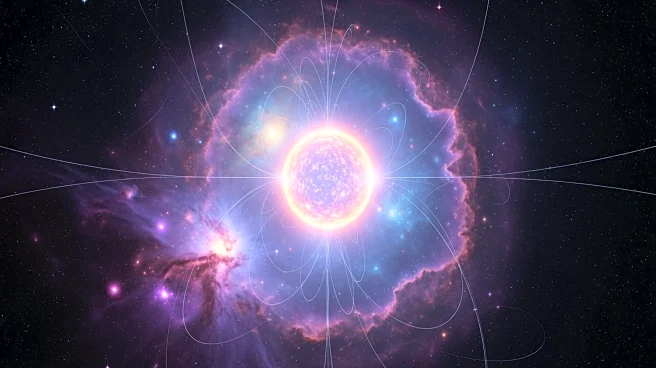
Scientists have identified a potential pulsar, a highly magnetic neutron star, at the center of the Milky Way. This discovery was made by the Breakthrough Listen team using the Green Bank Telescope in West Virginia. Pulsars are formed when massive stars
collapse, creating dense objects that emit beams of radio waves. The potential pulsar, dubbed the Breakthrough Listen Pulsar (BLPSR), rotates approximately 122 times per second. The discovery is significant as it could provide insights into the population of pulsars near the Milky Way's central supermassive black hole, Sagittarius A*. Despite the sensitivity of the survey, only one pulsar candidate was detected, raising questions about the expected number of pulsars in this region.
Why It's Important?
The discovery of a pulsar near the Milky Way's center could enhance our understanding of both the galaxy and the principles of general relativity. Pulsars serve as cosmic clocks, allowing scientists to study the effects of massive objects on spacetime. This could provide unprecedented tests of general relativity around supermassive black holes. The findings also challenge existing models of pulsar populations in the Galactic Center, prompting further investigation. The research could lead to advancements in astrophysics and a deeper understanding of the universe's fundamental forces.
What's Next?
Future astronomy projects, such as the next-generation Very Large Array and the Square Kilometer Array, are expected to provide more detailed observations of the Galactic Center. These projects could confirm the presence of the pulsar and help determine the population density of pulsars in this region. The ongoing investigation of the Breakthrough Listen Pulsar will continue, with scientists eager to explore its implications for our understanding of the Milky Way and general relativity.