









What's Happening?
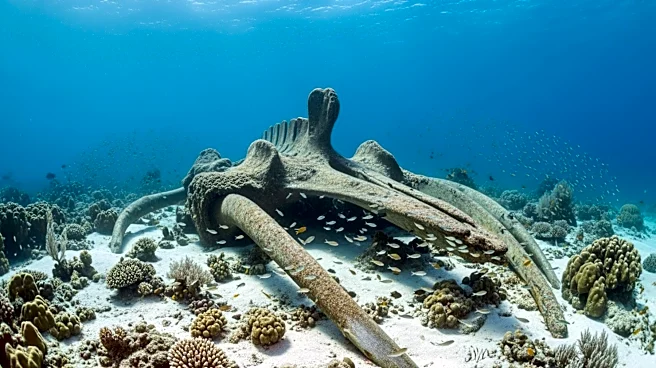
Scientists have discovered a deep-sea whale graveyard in the southeastern Indian Ocean, teeming with marine life. This site, located up to 23,000 feet below the surface, is the deepest and oldest of its kind found to date. The graveyard consists of whale carcasses
that have fallen to the sea floor, providing sustenance for various marine creatures such as jellyfish, tubeworms, and brittle stars. Researchers, including Xikun Song from the Chinese Academy of Sciences, have explored the site using deep-sea submersibles, uncovering five carcass sites and fossils, some dating back 5.3 million years. The findings, published in the journal Nature, suggest that the unique chemistry of whale bones supports diverse marine communities.
Why It's Important?
The discovery of this whale graveyard is significant as it provides insights into how life can thrive in extreme deep-sea environments. The site offers a unique opportunity to study the adaptation of marine life to conditions characterized by high pressure, low light, and limited oxygen. Understanding these ecosystems can enhance knowledge of biodiversity and evolutionary processes in the deep ocean. Additionally, the discovery highlights the potential for finding new species, as many of the creatures observed are likely undocumented. This research could inform conservation efforts and the management of deep-sea resources, emphasizing the importance of protecting these remote habitats.