


What's Happening?
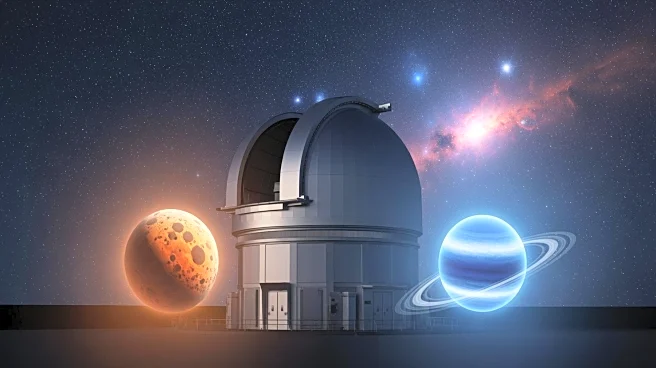
Astronomers using the Subaru Telescope have confirmed the discovery of two celestial objects: an exoplanet named HIP 54515 b and a brown dwarf named HIP 71618 B. These findings are the first confirmed results from the OASIS program, which combines data
from ESA's Hipparcos and Gaia missions with Subaru's imaging system. HIP 54515 b, located 271 light-years away in the Leo constellation, has a mass close to 18 times that of Jupiter and orbits its star at a distance similar to Neptune's orbit around the Sun. HIP 71618 B, a brown dwarf, is situated 169 light-years away in the Bootes constellation. These discoveries provide astronomers with new targets for detailed study and are significant for future space missions, including NASA's upcoming Roman Telescope.
Why It's Important?
The discovery of HIP 54515 b and HIP 71618 B is crucial for advancing astronomical research and technology. HIP 71618 B, in particular, serves as a key target for NASA's Nancy Grace Roman Space Telescope, which will test a coronagraph designed to block starlight and reveal faint nearby companions. This technology is essential for future telescopes aiming to photograph Earth-like planets around other stars. The confirmed presence of HIP 71618 B provides a stable and reliable target for early performance checks of the Roman Telescope, supporting efforts to image faint planets that are difficult to detect directly.
What's Next?
NASA's Roman Space Telescope is scheduled to launch in 2026 or 2027, and HIP 71618 B will be used to test its coronagraph systems. This will help evaluate the technology needed for future telescopes to photograph Earth-like planets. The OASIS program will continue to provide astronomers with new targets for study, potentially leading to further discoveries and advancements in understanding celestial bodies and their dynamics.