
What's Happening?
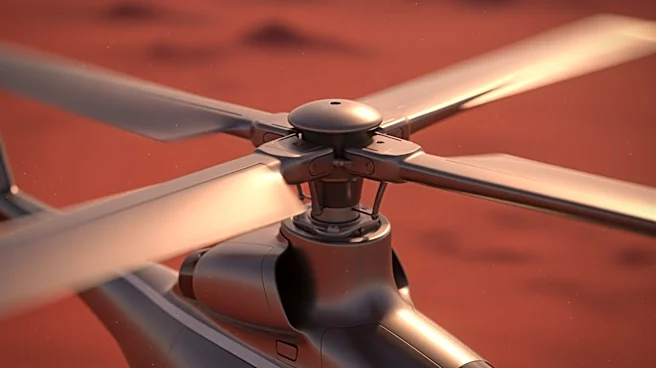
NASA has successfully tested rotor systems for Mars-bound helicopters, achieving supersonic speeds for the first time. Conducted at NASA's Jet Propulsion Laboratory, the tests involved two rotor systems reaching
speeds of Mach 1.08, surpassing the speed of sound on Mars. This breakthrough is part of Project SkyFall, which aims to deploy multiple helicopters for Mars exploration by December 2028. These helicopters are designed to operate in Mars' ultra-thin atmosphere, which is only 1% as dense as Earth's. The project builds on the success of the 2021 Ingenuity Mars Helicopter mission, which demonstrated the feasibility of powered flight on Mars. Ingenuity completed 72 flights, far exceeding its initial plan of five, and laid the groundwork for developing more advanced rotor systems.
Why It's Important?
The successful testing of supersonic rotor speeds is a significant milestone for Mars exploration. It enables the development of larger, more capable helicopters that can carry advanced scientific instruments and communication systems. This advancement could revolutionize Mars exploration by allowing for more extensive aerial surveys and data collection, which are crucial for future robotic and human missions. The ability to fly in Mars' thin atmosphere opens new possibilities for exploring regions that are inaccessible to ground-based rovers, potentially leading to groundbreaking scientific discoveries.
What's Next?
Project SkyFall is set to launch in December 2028, with plans to deploy three next-generation helicopters on Mars. These helicopters will conduct independent exploration missions, using a landed spacecraft as their operational base. The success of these missions could pave the way for more ambitious exploration projects, including human missions to Mars. NASA's continued innovation in rotor technology will likely lead to further advancements in aerial exploration capabilities, enhancing our understanding of the Martian environment.