
What's Happening?
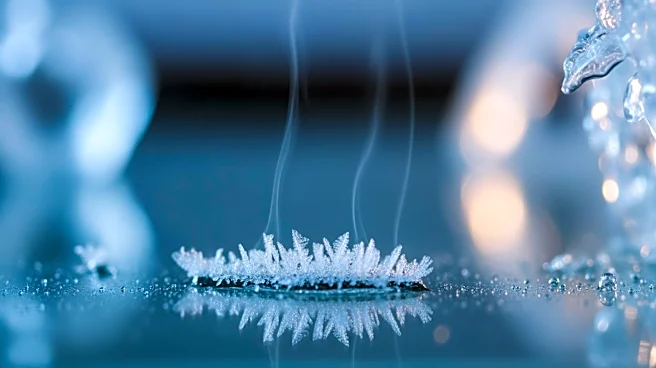
A team of researchers at the University of Illinois Urbana-Champaign, led by Professor Nenad Miljkovic, has discovered a new mechanism for frost propagation, termed 'suspended ice bridges.' This breakthrough,
published in Nature Physics, challenges the traditional understanding of frost formation, which assumed ice bridges grow along solid surfaces. The study reveals that on superhydrophobic surfaces, ice bridges can form suspended above the surface, connecting droplets through the air. This discovery was made using high-resolution optical microscopy and focal plane shift imaging. The research highlights that surface wettability is crucial in determining the growth mode of ice bridges, with a critical contact angle threshold identified. The findings suggest that suspended ice bridges grow slower due to reduced thermal coupling, significantly suppressing frost propagation on superhydrophobic surfaces.
Why It's Important?
This discovery has significant implications for industries reliant on efficient thermal management, such as air conditioning, refrigeration, and aerospace. By understanding and controlling frost propagation, energy systems can operate more efficiently, reducing energy consumption and costs. The ability to delay frost formation and slow its spread can enhance the performance and longevity of heat exchangers and other critical components. This research provides a new framework for designing anti-frosting surfaces, potentially leading to advancements in energy-efficient technologies and improved system reliability. The findings could influence future research in phase change phenomena and interfacial transport, contributing to the development of innovative solutions for energy and thermal management challenges.
What's Next?
The research team plans to further explore the practical applications of their findings in commercial settings, particularly in finned-tube heat exchangers. By promoting the formation of suspended ice bridges, these systems could achieve prolonged efficient operation. The study opens avenues for designing advanced surfaces that control frost spreading, which could be applied across various industries. Future research may focus on optimizing surface designs to maximize the benefits of this new understanding of frost dynamics. Additionally, the insights gained could lead to collaborations with industry partners to develop and implement these technologies in real-world applications.
Beyond the Headlines
The discovery of suspended ice bridges not only challenges existing theories but also introduces a three-dimensional perspective to frost propagation. This shift in understanding could lead to broader implications in the study of phase change and interfacial heat transfer. The research underscores the importance of surface properties in controlling thermal processes, which could inspire new approaches in material science and engineering. As industries seek to improve energy efficiency and sustainability, the ability to manipulate frost dynamics at the microscopic level could become a critical factor in achieving these goals.