



What's Happening?
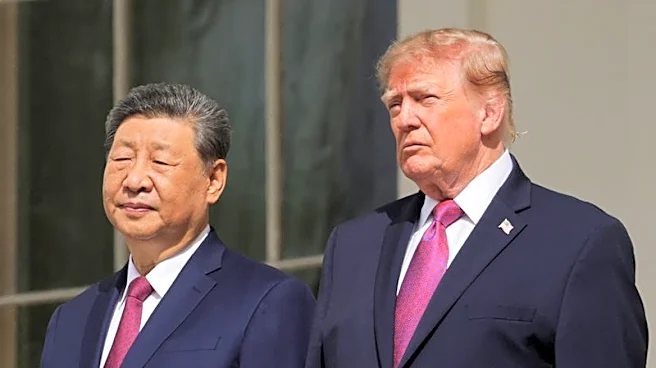
The United States continues to heavily rely on China for critical minerals, a situation that places President Trump in a challenging position ahead of his scheduled talks with Chinese President Xi Jinping. Despite previous efforts to secure domestic supplies,
U.S. manufacturers remain dependent on Chinese materials essential for producing semiconductors, robotics, weapon systems, and artificial intelligence technologies. This dependence limits President Trump's leverage in trade negotiations concerning tariffs and export controls, as pressuring China too much risks disrupting access to vital metals, magnets, and chemical compounds not sufficiently produced in the U.S. China has previously used its dominant position as a producer of rare-earth elements as leverage, including restricting mineral exports last year, which impacted operations for companies like Ford Motor. Analysts note that the gap between President Trump's ambitions for mineral independence and the slow pace of implementation reflects the difficulty of rebuilding an industry largely abandoned by the U.S. in the late 20th century. China, conversely, has spent decades developing extensive processing, refining, technical expertise, and manufacturing infrastructure for these raw materials.
Why It's Important?
The persistent U.S. reliance on Chinese critical minerals poses significant economic and national security risks. Economically, it leaves U.S. industries vulnerable to supply chain disruptions and price volatility dictated by Chinese policy. Any restrictions on these minerals by China could severely impact key manufacturing sectors, including defense, automotive, and technology, potentially leading to production slowdowns and increased costs. From a national security perspective, this dependence creates a strategic vulnerability, as essential components for advanced military hardware and critical infrastructure rely on foreign sources. This situation undermines the U.S.'s ability to independently pursue its strategic interests and places it at a disadvantage in geopolitical negotiations. The lack of domestic production capacity for materials like neodymium-iron-boron magnets, where China's output vastly overshadows that of the U.S., highlights a critical gap in the U.S. industrial base. Rebuilding this capacity is crucial for long-term economic resilience and strategic autonomy.
What's Next?
The upcoming meeting between President Trump and President Xi Jinping will likely test the U.S. strategy regarding critical minerals. There is a possibility that both leaders may agree to extend the existing trade truce, which includes exemptions from export controls on certain critical minerals and is set to expire in January. However, without significant progress in developing domestic mineral supply chains, the U.S. will continue to face limited options in future trade discussions. The Trump administration has initiated steps to accelerate mineral extraction projects, but the development of new mines, refineries, and processing facilities typically requires a decade or more to become operational. Therefore, immediate solutions to reduce dependence are unlikely. Future policy efforts will need to focus on long-term investments in mining, processing infrastructure, and technological innovation to create a more self-sufficient supply chain for critical minerals within the United States.
Beyond the Headlines
The issue of critical mineral dependence extends beyond immediate trade negotiations, touching upon broader themes of industrial policy, environmental regulation, and global resource competition. The U.S. faces challenges in expanding domestic mining and processing due to stringent environmental regulations and community opposition, which often prolong project timelines. China's decades-long strategic investment in this sector, including its willingness to accept higher environmental costs, has given it a significant competitive advantage. This situation highlights a fundamental tension between economic growth, national security, and environmental stewardship in developed nations. Furthermore, the global race for critical minerals is intensifying as demand for electric vehicles, renewable energy technologies, and advanced electronics grows. The U.S. will need to navigate these complex interdependencies, potentially exploring international partnerships and innovative recycling technologies, in addition to domestic extraction, to secure its long-term supply of these essential resources.