





What's Happening?
Recent research published in Communications Earth & Environment has revealed significant insights into the vertical currents of the Southern Ocean. Utilizing high-resolution satellite data and robotic underwater gliders, scientists have discovered that
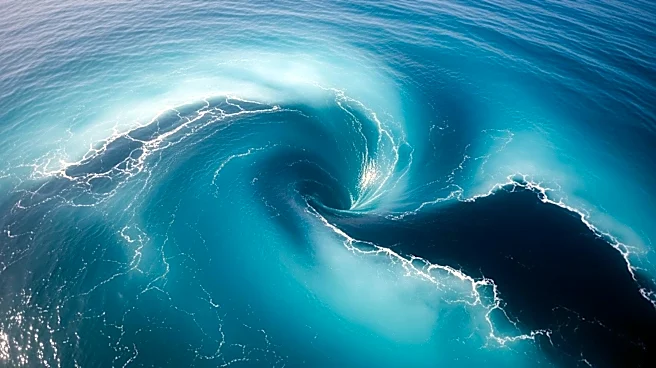
these currents are more intense and reach deeper than previously understood. The study, led by Andrew F. Thompson from the California Institute of Technology, involved a five-week expedition in the Southern Ocean, coinciding with the overhead passage of the SWOT satellite. This satellite measures ocean surface height, allowing researchers to identify features between 10 to 100 kilometers across. The team also deployed autonomous underwater gliders to collect data on water density, temperature, and salinity, which were then integrated into an ocean model to assess the speed of vertical water movement. The findings indicate that these vertical currents, driven by ocean whirlpools known as eddies, extend at least 3,000 feet into the ocean and can move water at speeds exceeding 330 feet per day.
Why It's Important?
Understanding the dynamics of vertical ocean currents is crucial for predicting global climate change, as these currents play a significant role in the ocean's ability to absorb heat and carbon. The Southern Ocean, in particular, is a key area for studying these processes due to its influence on global ocean circulation. The new insights from this research could improve models of heat and carbon transport, enhancing predictions of future climate change impacts. This knowledge is vital for policymakers and scientists working on climate mitigation strategies, as it provides a clearer picture of how oceanic processes contribute to global warming. The study's findings could lead to more accurate climate models, which are essential for developing effective environmental policies and understanding the long-term effects of climate change on ecosystems and human societies.
What's Next?
The research team aims to extend their findings to other regions of the Southern Ocean and beyond, to better understand the global implications of these vertical currents. Future studies will likely focus on how these currents vary over time and their impact on the global climate system. The data collected could also be used to refine existing climate models, providing more precise predictions of oceanic heat and carbon absorption. As the scientific community continues to explore these deep-sea processes, there may be increased collaboration between oceanographers and climate scientists to address the challenges posed by climate change. Additionally, the findings could influence international climate policy discussions, emphasizing the importance of oceanic research in understanding and mitigating climate change.