
What's Happening?
Three teenagers in South Carolina were arrested and accused of destroying a Flock Safety camera, causing its battery to explode and ignite a fire near homes. This incident occurred on Harmony Church Road
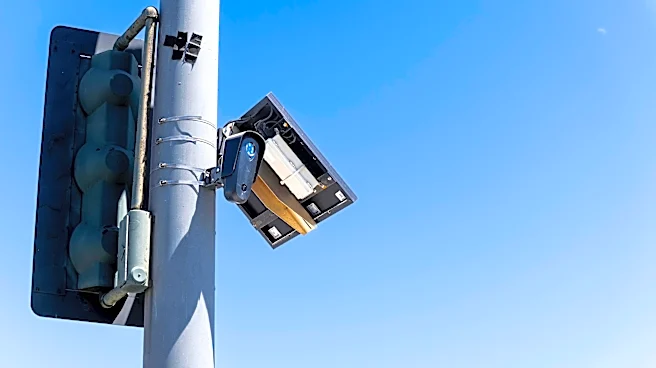
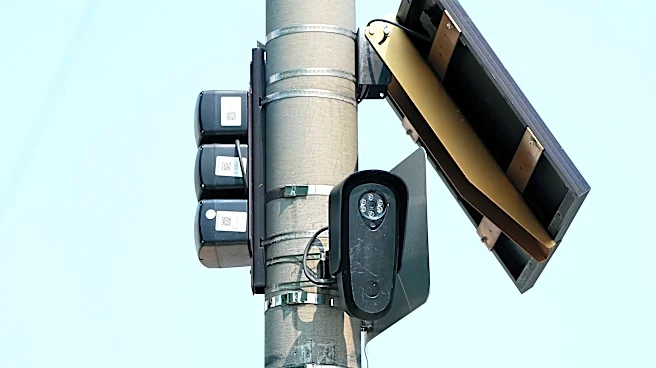
in Chester County on August 15. Investigators reported that the teenagers cut down the camera pole and then struck the equipment with a hammer, leading to the battery fire. The Chester County Sheriff's Office estimated the damages to be over $5,000. Blaze Fuller, Samuel Carlisle, and James Ryerson, all 19, were charged with felony conspiracy and malicious damage to private property. This event highlights growing national tensions surrounding Flock's automatic license plate reader network, with privacy advocates, local authorities, and lawmakers expressing opposition to the expansion of vehicle location databases. Senator Josh Hawley, a Republican from Missouri, has initiated an investigation into Flock, alleging the company has created an 'unprecedented national surveillance network' with over 120,000 cameras across 49 states, scanning more than 20 billion vehicles monthly. Critics argue that these cameras, using artificial intelligence, compile images into a national database accessible to clients, moving beyond specific local investigations.
Why It's Important?
The destruction of the Flock Safety camera and the subsequent arrests underscore the escalating debate over privacy versus public safety in the United States. The incident in South Carolina, while a criminal act, occurs within a broader context of public concern regarding surveillance technology. The involvement of lawmakers like Senator Hawley, who criticizes Flock's extensive network as an 'unprecedented national surveillance network,' signifies that this is not merely a local issue but a significant national policy challenge. The debate touches upon fundamental constitutional rights, particularly the Fourth Amendment's protection against unreasonable searches and seizures. The use of AI-powered cameras to create a national database of vehicle movements raises questions about the scope of government and private entity surveillance, data retention, and potential misuse. The actions of Hood County officials in Texas, who voted to end their relationship with Flock and covered their cameras, demonstrate a growing resistance at the local level to what some perceive as pervasive, warrantless tracking. This issue has the potential to influence future legislation regarding data privacy, surveillance technology, and the balance between security measures and individual liberties.
What's Next?
The ongoing investigation by Senator Josh Hawley into Flock Safety's surveillance network is expected to continue, potentially leading to congressional hearings or legislative proposals aimed at regulating such technologies. Flock's spokesperson, Paris Lewbel, has indicated the company will respond directly to Hawley's inquiries, explaining their platform's security measures and how law enforcement uses Flock to solve crimes and locate missing persons. This response will likely be scrutinized by privacy advocates and lawmakers. Communities across the U.S., following examples in Texas and Arizona, may continue to re-evaluate or terminate their contracts with Flock due to concerns over data sharing, privacy, and potential misuse. The legal proceedings against the teenagers in South Carolina will also unfold, potentially setting precedents for how acts of vandalism against surveillance infrastructure are prosecuted. Furthermore, the broader public discourse on the balance between public safety and individual privacy is likely to intensify, influencing future policy decisions at both state and federal levels regarding the deployment and regulation of surveillance technologies.
Beyond the Headlines
The controversy surrounding Flock Safety cameras extends beyond immediate legal and privacy concerns, touching upon deeper ethical and societal implications. The deployment of such extensive surveillance networks, even with the stated goal of crime prevention, raises questions about the erosion of anonymity in public spaces and the potential for a 'chilling effect' on civil liberties. The argument that these cameras create a 'national surveillance network' without judicial oversight challenges the traditional understanding of privacy in a free society. The debate also highlights the tension between technological advancement and democratic values, particularly when private companies develop and manage tools that can be used for mass surveillance. The actions of individuals like Agent John Shirley, who advocates for good policing while insisting on limits to government surveillance, reflect a growing sentiment that public safety should not come at the cost of unlimited surveillance capabilities. This ongoing discussion could lead to a redefinition of privacy rights in the digital age, influencing how future technologies are integrated into society and how personal data is collected, stored, and utilized by both governmental and private entities.