
What's Happening?
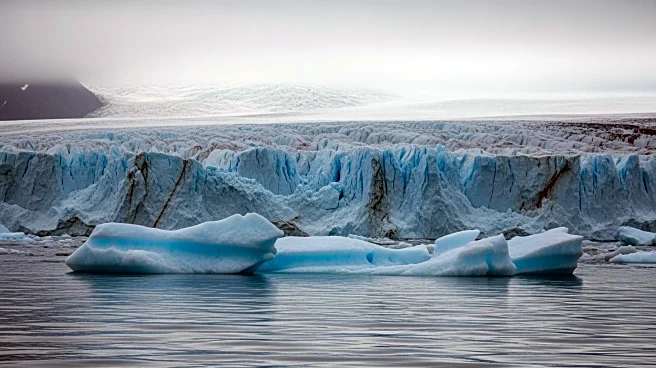
Recent research has identified hundreds of iceberg-induced earthquakes occurring at the Thwaites Glacier, also known as the Doomsday Glacier, in Antarctica. These glacial earthquakes are generated when
large icebergs break off and collide with the glacier, creating seismic waves that can travel thousands of kilometers. Unlike typical seismic events, these do not produce high-frequency waves, making them harder to detect with standard seismic monitoring networks. The study, published in Geophysical Research Letters, found over 360 such events between 2010 and 2023, primarily at the ocean end of Thwaites Glacier. This discovery is significant as the Thwaites Glacier is a major contributor to sea-level rise, and its potential collapse could drastically increase global sea levels.
Why It's Important?
The detection of these glacial earthquakes is crucial for understanding the stability of the Thwaites Glacier, which is a significant concern for global sea-level rise. The glacier's collapse could lead to a rise in sea levels by up to 10 feet, posing a threat to coastal communities worldwide. The study highlights the impact of ocean conditions on the glacier's stability, suggesting that changes in ocean temperatures and currents could accelerate the glacier's movement towards the sea. This research underscores the need for improved monitoring and understanding of glacial dynamics in Antarctica, as these factors are critical for predicting future sea-level changes and preparing for their potential impacts.
What's Next?
Further research is needed to explore the interactions between the ocean, ice, and solid ground at the Thwaites Glacier. Understanding these dynamics could help resolve uncertainties in sea-level rise projections. Additionally, the study calls for more localized seismic monitoring in Antarctica to better detect and analyze glacial earthquakes. This could provide valuable insights into the short-term impacts of oceanic conditions on glacier stability and inform global climate models. Continued satellite observations and field studies will be essential in tracking the glacier's behavior and assessing its potential contribution to future sea-level rise.
Beyond the Headlines
The findings from this study highlight the broader implications of climate change on polar regions. As global temperatures rise, the frequency and intensity of glacial earthquakes may increase, further destabilizing ice sheets and accelerating sea-level rise. This research also raises questions about the effectiveness of current seismic monitoring networks in detecting low-magnitude events in remote regions like Antarctica. Enhancing these networks could improve our ability to monitor and respond to changes in the Earth's cryosphere, which is vital for global climate resilience.