
What's Happening?
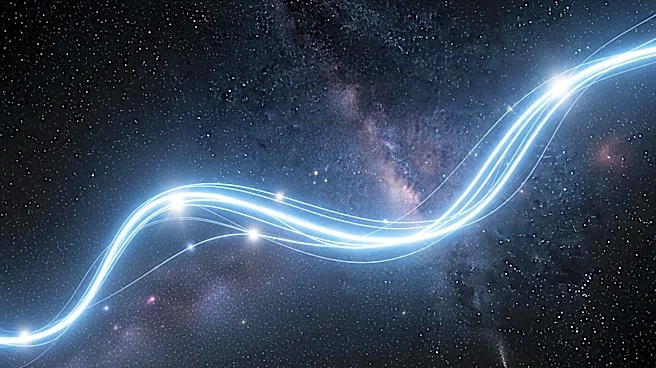
Astronomers have discovered a multitude of faint stellar streams in the outskirts of the Milky Way, using data from the European Space Agency's Gaia mission. These streams, which are arcing threads of stars, can be multiplied four times more than previously
known. The discovery was made possible by a new algorithm that analyzes the gravitational forces experienced by these streams. The findings provide insights into the evolution of the Milky Way and the distribution of its dark matter. Oleg Gnedin, a theoretical astrophysicist at the University of Michigan, likened the process to riding a bike with a bag of sand that has a hole, where the grains of sand represent stars left behind along their trajectory.
Why It's Important?
The discovery of these stellar streams is significant as it enhances the understanding of the Milky Way's structure and the distribution of dark matter, which acts as an invisible 'glue' holding galaxies together. Although dark matter has not been directly observed, its effects are crucial for understanding galactic dynamics. The ability to map these streams provides astronomers with a tool to measure the mass of the Milky Way and its dark matter halo, offering potential advancements in astrophysics and cosmology. This could lead to new theories about galaxy formation and the role of dark matter in the universe.
What's Next?
Future research will likely focus on further analyzing these stellar streams to refine models of the Milky Way's mass and dark matter distribution. Astronomers may use additional data from Gaia and other missions to explore the implications of these findings on galactic evolution. The scientific community may also develop new algorithms to enhance the detection and analysis of such streams, potentially leading to breakthroughs in understanding the universe's fundamental components.
Beyond the Headlines
The discovery of stellar streams not only contributes to astrophysical knowledge but also raises questions about the nature of dark matter and its elusive properties. As scientists continue to explore these cosmic phenomena, ethical considerations regarding the allocation of resources for space research may arise. Additionally, cultural implications of understanding our galaxy's structure could influence public interest in space exploration and science education.