



What's Happening?
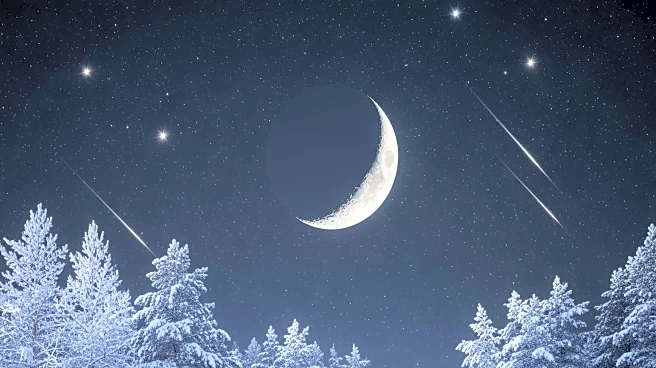
On December 21, 2025, the Northern Hemisphere experiences the winter solstice, marking the shortest day and longest night of the year. This astronomical event coincides with the Ursid meteor shower, providing ideal conditions for stargazing due to a thin
crescent moon that keeps the skies dark. The solstice occurs at 15:03 UTC, translating to 10:03 a.m. EST in New York. The Ursid meteor shower is expected to peak between December 21 and 22, with forecasts suggesting the best viewing times are from midnight to pre-dawn. Additionally, Jupiter is prominently visible in the night sky, and the interstellar comet 3I/ATLAS, which recently made its closest pass to Earth, remains a target for telescope users.
Why It's Important?
The winter solstice and accompanying meteor shower present a significant opportunity for astronomers and the general public to engage with the night sky. The event highlights the intersection of natural phenomena and cultural traditions, as people gather to observe these celestial occurrences. The visibility of Jupiter and the rare interstellar comet 3I/ATLAS adds to the excitement, offering both amateur and professional astronomers a chance to observe unique celestial bodies. This event underscores the importance of dark skies for astronomical observations and the cultural significance of solstices in human history.
What's Next?
Following the solstice, the Ursid meteor shower will continue to be active for several days, although the peak viewing period is expected to end by December 22. As the moon becomes more illuminated, stargazing conditions will gradually become less favorable. Jupiter will continue to be a prominent feature in the night sky, building towards its opposition in early January 2026, when it will be visible all night. The interstellar comet 3I/ATLAS will remain a point of interest for astronomers, although it requires a telescope for observation.