



What's Happening?
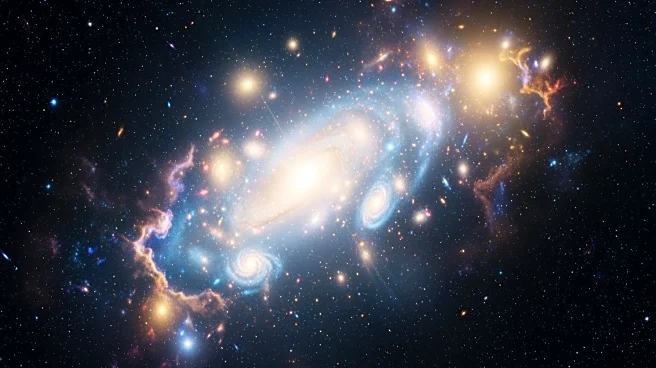
The James Webb Space Telescope (JWST), in conjunction with NASA's Chandra X-ray space telescope, has observed the formation of the most distant galaxy cluster ever seen, designated JADES-ID1. This protocluster was forming just 1 billion years after the Big
Bang, much earlier than previously thought possible. The light from JADES-ID1 has been traveling to Earth for 12.7 billion years, revealing a phase of rapid galaxy cluster formation. This discovery challenges existing models of galaxy cluster formation, which did not predict such density of galaxies so soon after the universe's origin.
Why It's Important?
This discovery provides new insights into the early universe and the formation of galaxy clusters, which are the largest gravitationally bound structures in the cosmos. Understanding how these clusters form and evolve is crucial for astronomers to better calculate the universe's expansion rate and the distribution of dark matter. The findings could lead to revisions in current cosmological models and enhance our understanding of the universe's history and structure.
What's Next?
Further observations and studies will be needed to understand the mechanisms that allowed such rapid formation of galaxy clusters. Scientists will likely focus on refining models of galaxy cluster formation and exploring the implications for dark matter and cosmic evolution. The JWST and other telescopes will continue to play a critical role in uncovering the mysteries of the early universe.
Beyond the Headlines
The rapid formation of galaxy clusters like JADES-ID1 raises questions about the processes that drive cosmic evolution. It suggests that the universe may have been more dynamic in its early stages than previously thought, potentially leading to new theories about the role of dark matter and energy in cosmic development. This discovery also highlights the importance of advanced telescopes in expanding our understanding of the universe.