




What's Happening?
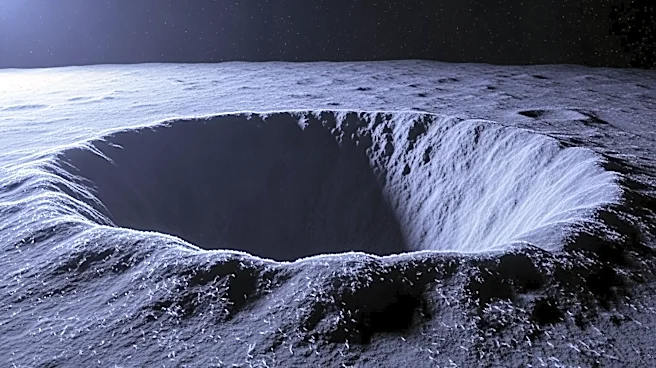
Researchers from the Weizmann Institute of Science, in collaboration with U.S. scientists, have identified 'cold traps' on the Moon's surface where ice has been accumulating for over 1.5 billion years. These cold traps, located in permanently shadowed
regions near the Moon's poles, maintain extremely low temperatures necessary for ice preservation. The study, published in Nature Astronomy, highlights the significance of these areas as prime targets for future lunar missions. The research aims to understand the distribution and age of lunar ice, which could be crucial for future space exploration and the establishment of lunar bases.
Why It's Important?
The discovery of cold traps on the Moon is pivotal for space exploration, as lunar ice is a valuable resource. It can be converted into water for consumption, rocket fuel, and used for scientific research. Understanding the distribution of ice on the Moon could aid in planning future missions, including NASA's Artemis program, which aims to establish a permanent human presence on the Moon. The findings also provide insights into the Moon's geological history and the potential for similar resources on other celestial bodies.
What's Next?
Future lunar missions, including those under NASA's Artemis program, are expected to target these cold traps for exploration and sampling. The data collected could confirm the presence of ice and help determine its origin, whether from volcanic activity, solar wind, or comet impacts. This research could also inform the development of technologies for utilizing lunar resources, supporting long-term human habitation and exploration of the Moon and beyond.
Beyond the Headlines
The study of lunar ice not only advances space exploration but also contributes to our understanding of planetary science. By analyzing the chemical composition of lunar ice, scientists can draw parallels with Earth's water, offering clues about the history of water in our solar system. This research could also influence the search for water on other planets and moons, potentially guiding future missions to Mars and beyond.