What's Happening?
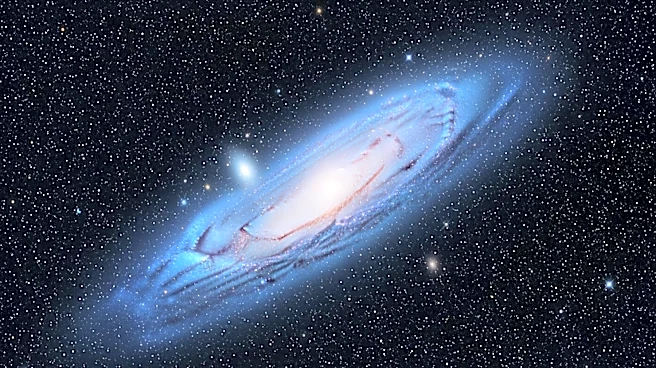
A recent study has provided the largest-scale test of Newton's law of gravity, confirming its validity across vast cosmic distances. Researchers measured the velocities of galaxy clusters located 5 to 7
billion light-years away, using the kinematic Sunyaev-Zeldovich effect to analyze the cosmic microwave background. The study involved around 686,000 galaxies, many of which are gravitationally bound in clusters. The findings showed that the gravitational pull between these clusters diminishes with distance, consistent with Newton's and Einstein's theories. This supports the existence of dark matter as a more plausible explanation for the gravitational anomalies observed in the universe, rather than modifications to the laws of gravity.
Why It's Important?
The confirmation of Newton's law of gravity on such a large scale reinforces the current understanding of gravitational forces and supports the dark matter hypothesis. This has significant implications for cosmology and astrophysics, as it strengthens the case for dark matter being a major component of the universe's mass. Understanding gravity's behavior at cosmic scales is crucial for developing accurate models of the universe's structure and evolution. The study's results may guide future research in identifying the nature of dark matter, which remains one of the most significant mysteries in physics.
Beyond the Headlines
The study highlights the ongoing challenge of understanding dark matter, which constitutes about 85% of the universe's mass. While the research supports the existence of dark matter, it does not identify its composition, leaving many questions unanswered. The findings emphasize the need for continued exploration of both dark matter and gravitational theories. This research could inspire new approaches to detecting dark matter and refining gravitational models, potentially leading to groundbreaking discoveries in fundamental physics.