


What's Happening?
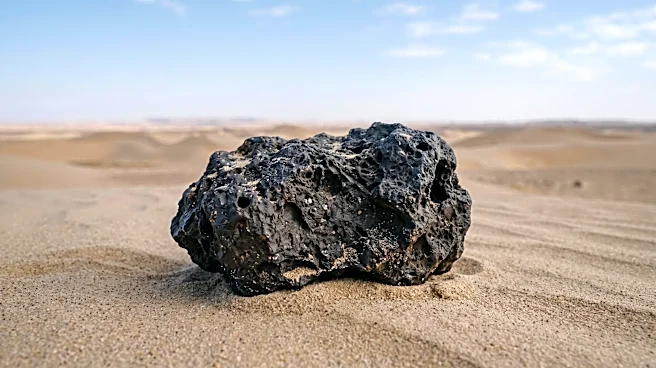
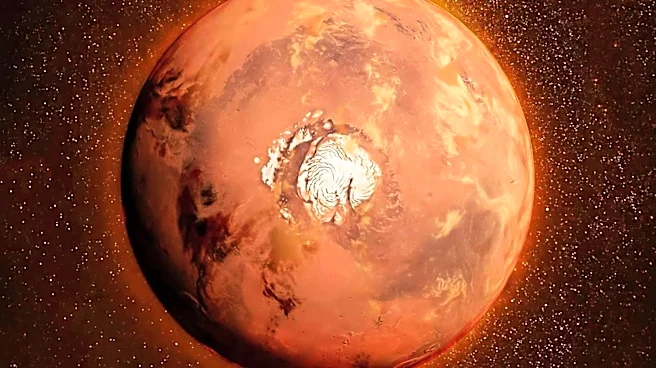
A meteorite discovered in the Sahara Desert has been identified as originating from Mars approximately 4.1 billion years ago. Analysis by NASA-funded researchers revealed that this meteorite, named 'Tegaza 001,' formed in the crust of Mars during its
early history. Initially classified as a common type of Martian meteorite, further high-precision analysis by Yang Liu and colleagues at NASA's Jet Propulsion Laboratory, in collaboration with the California Institute of Technology, determined its ancient origin. This makes Tegaza 001 one of the three oldest Martian meteorites ever found on Earth. The findings suggest the existence of a significant water cycle on Mars during its early formation, indicating a potentially more Earth-like past for the red planet.
Why It's Important?
The discovery and analysis of Tegaza 001 are profoundly important for understanding the early geological and hydrological history of Mars. Evidence of a large water cycle 4.1 billion years ago provides crucial insights into the conditions that existed on Mars when life was potentially emerging on Earth. This suggests that early Mars might have been a more habitable environment than previously thought, with implications for the potential for past or even present microbial life on the planet. The meteorite offers a tangible sample of Mars' ancient crust, allowing scientists to study its composition and evolution directly, which complements data gathered by rovers and orbiters. This direct evidence helps refine models of planetary formation and evolution in our solar system.
What's Next?
Further detailed analysis of Tegaza 001 and other ancient Martian meteorites will continue to provide valuable data about Mars' early environment. Researchers will likely focus on identifying specific minerals and isotopic signatures within the meteorite that can offer more precise details about the presence and movement of water. This information will guide future Mars missions, helping to identify regions of interest for exploration where ancient water activity was prevalent. The findings could also influence the design of instruments for upcoming missions, optimizing them to detect similar geological and hydrological evidence on Mars' surface. The ongoing study of such meteorites will contribute to a more complete picture of Mars' habitability through time.
Beyond the Headlines
The existence of an ancient water cycle on Mars, as suggested by Tegaza 001, opens up broader discussions about planetary habitability and the conditions necessary for life. It challenges the perception of Mars as always having been a dry, desolate world, instead painting a picture of a dynamic early planet. This discovery fuels the ongoing debate about whether life could have originated on Mars and, if so, what happened to it. It also highlights the importance of meteorites as natural probes, delivering samples from other celestial bodies directly to Earth, offering unique opportunities for study that complement expensive space missions. The implications extend to exoplanetary science, as understanding early Mars helps scientists identify potentially habitable exoplanets.