



What's Happening?
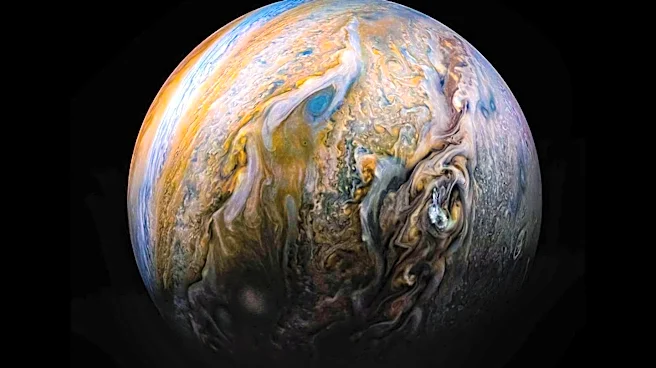
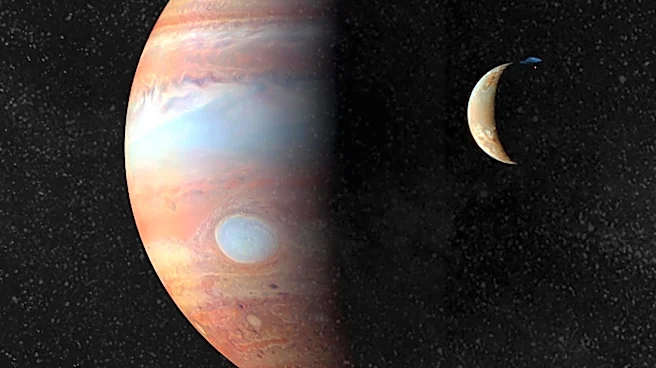
Europa, one of Jupiter's moons, contains an ocean beneath its icy surface that holds more liquid water than all of Earth's oceans combined. This ocean remains liquid due to the gravitational pull of Jupiter and the orbital resonance with its neighboring
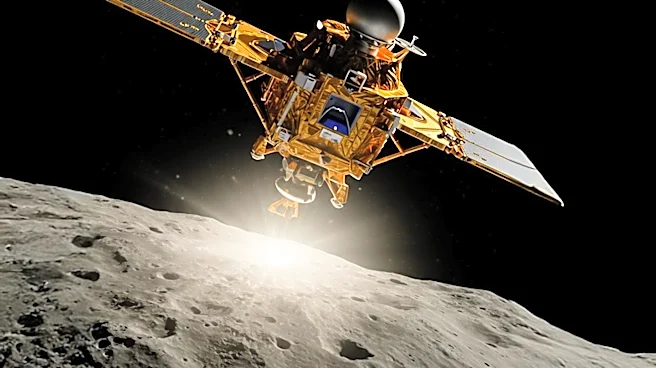
moons, Io and Ganymede. This gravitational interaction prevents Europa from settling into a circular orbit, maintaining tidal forces that generate internal heat. NASA's upcoming Europa Clipper mission aims to study this phenomenon through multiple flybys, using instruments to analyze the moon's ice structure and ocean characteristics.
Why It's Important?
Understanding Europa's ocean is crucial for astrobiology, as it may harbor conditions suitable for life. The study of Europa's tidal heating and ocean dynamics can provide insights into similar processes on other celestial bodies, expanding our knowledge of potential habitable environments beyond Earth. The mission also highlights the importance of international collaboration in space exploration and the technological advancements required to study distant worlds.
What's Next?
NASA's Europa Clipper mission, set to arrive in 2030, will conduct 49 flybys of Europa, gathering data to determine the ocean's depth, salinity, and potential for supporting life. The mission will use radar, magnetometers, and spectrometers to analyze the moon's surface and subsurface, aiming to provide a comprehensive understanding of Europa's geophysical properties.