


What's Happening?
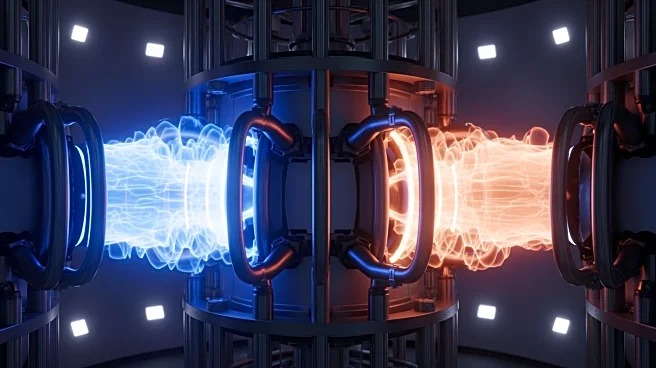
Physicists at the Experimental Advanced Superconducting Tokamak (EAST) in China have successfully exceeded the Greenwald limit, a previously accepted density boundary for plasma in fusion reactors. By precisely controlling the plasma's interaction with
reactor walls and employing electron cyclotron resonance heating, researchers achieved plasma densities 65% higher than the traditional limit. This breakthrough challenges the long-standing assumption that the Greenwald limit is a fundamental barrier, suggesting that with the right conditions, fusion reactors can operate in a 'density-free' regime.
Why It's Important?
This development is significant for the future of nuclear fusion as a viable energy source. Overcoming the Greenwald limit could lead to more efficient and powerful fusion reactors, potentially providing a sustainable and clean energy solution. The ability to operate at higher plasma densities means increased energy output, which is crucial for making fusion energy commercially viable. This advancement could accelerate the development of fusion technology, impacting global energy markets and contributing to efforts to reduce reliance on fossil fuels.
What's Next?
Following this breakthrough, further experiments will be conducted to explore the full potential of operating in the 'density-free' regime. Researchers will aim to refine the techniques used to control plasma-wall interactions and optimize reactor conditions. The findings could inform the design of next-generation fusion reactors, paving the way for practical applications of fusion energy. Continued international collaboration and investment in fusion research will be essential to realize the potential of this technology and address global energy challenges.