





What's Happening?
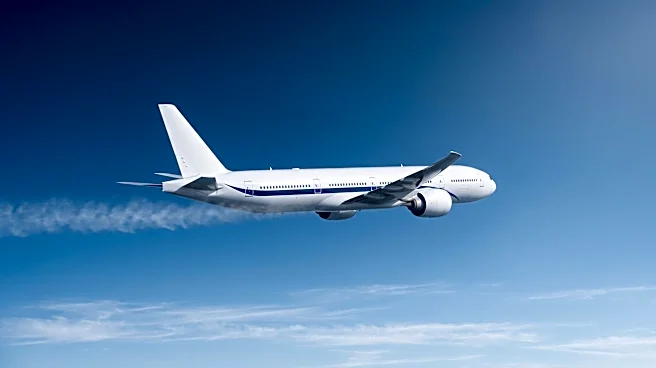
Google's artificial intelligence has demonstrated a significant reduction in climate warming caused by airplane contrails. In a recent trial, Google's AI-based predictions and open-source contrail models guided pilots to avoid specific pockets of humid
air that are prone to generating persistent contrails. This intervention successfully cut the warming effect of these contrails by approximately 40%. Contrails, the condensation trails left by aircraft, can trap heat in the atmosphere, contributing to climate change, with estimates suggesting they are responsible for up to one-third of all aviation-related warming. The AI system analyzes satellite imagery to predict where persistent contrails are most likely to form, allowing airlines to make minor altitude adjustments to mitigate their impact. This follows a previous trial in the U.S. with American Airlines, where 70 flights saw a 54% reduction in contrail generation.
Why It's Important?
This development holds significant importance for the aviation industry and global climate change mitigation efforts. Aviation is a major contributor to greenhouse gas emissions, and contrails represent a substantial, yet often overlooked, component of its climate impact. Google's AI solution offers a practical and relatively low-cost method to reduce this warming effect without requiring radical changes to aircraft design or fuel types. The ability to achieve a 40% reduction in contrail warming, as demonstrated in the Cathay Pacific trial, could lead to a measurable decrease in aviation's overall climate footprint. While increased fuel usage for altitude adjustments is a consideration, Google suggests that by focusing on the most impactful flights, the overall increase could be as low as 0.3% across an airline's operations, making it a viable strategy for environmental improvement. This technology could set a new standard for sustainable aviation practices.
What's Next?
Google is planning a larger-scale trial with Cathay Pacific, involving more flights, to further accelerate contrail research and achieve faster, more effective impacts on climate change mitigation. Additionally, there is growing interest in this initiative in Europe. Google has launched 'Operation Blue Skies' in cooperation with several major UK entities, targeting the Shanwick Oceanic corridor in the North Atlantic. Over the next 30 months, more than 10,000 flights passing through this corridor during trial hours will be required to adjust their altitudes to avoid generating contrails. The UK's Met Office, NATS air navigation service provider, Imperial College London, and the University of Cambridge will collaborate with Google and other organizations to analyze the data and determine the program's effectiveness. If successful, this initiative could serve as a blueprint for future trials and the expansion of the scheme globally to further reduce aviation-related climate warming.
Beyond the Headlines
The successful application of AI to mitigate contrail warming highlights the broader potential of artificial intelligence in addressing complex environmental challenges. This initiative moves beyond theoretical models to demonstrate tangible, real-world impact, showcasing how advanced computational power can be leveraged for ecological benefit. However, it also brings to light the paradox of AI's own environmental footprint; Google's emissions have significantly increased in recent years due to its AI data centers. This underscores the critical need for sustainable AI development and deployment, where the environmental benefits of AI applications outweigh the energy consumption required to run them. The project also emphasizes the importance of international collaboration between technology companies, airlines, and meteorological organizations to tackle global issues like climate change effectively. The ethical implications of AI-driven decision-making in aviation, even for environmental purposes, will also need careful consideration as these systems become more integrated into operational procedures.