


What's Happening?
Researchers at the Massachusetts Institute of Technology (MIT) have announced the development of a 'speech-to-reality' system that allows users to create furniture and other objects by simply speaking commands to a robotic arm. This innovative system integrates
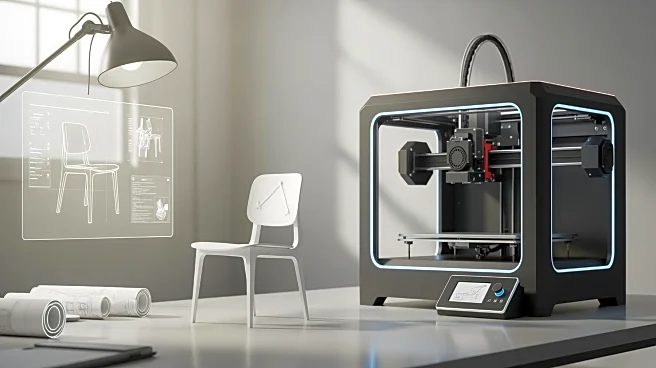
natural language processing, 3D generative AI, and robotic assembly to produce physical items in as little as five minutes. The project, led by graduate student Alexander Htet Kyaw, aims to make design and manufacturing more accessible to individuals without expertise in 3D modeling or robotic programming. The system uses modular components to construct items like stools, shelves, and tables, and can even create decorative objects. The team is working on improving the system's capabilities, including enhancing the weight-bearing capacity of the furniture and incorporating gesture recognition for more intuitive control.
Why It's Important?
This development represents a significant advancement in the field of automated manufacturing and design, potentially transforming how everyday objects are produced. By enabling rapid and accessible creation of furniture, the system could democratize manufacturing, allowing individuals and small businesses to produce custom items without the need for extensive resources or technical knowledge. This could lead to a reduction in waste, as modular components can be reassembled into different objects, promoting sustainability. The system's ability to quickly produce items could also have implications for industries that require rapid prototyping and production, such as interior design and architecture. Furthermore, the integration of AI and robotics in this manner could pave the way for future innovations in automated production processes.
What's Next?
The MIT team plans to enhance the system by improving the connections between modular components to increase the strength and durability of the assembled furniture. They are also exploring the use of small, distributed mobile robots to expand the system's capabilities to larger structures. Additionally, the incorporation of gesture recognition alongside speech control is being developed to provide users with more intuitive interaction options. These advancements could further broaden the system's applications and accessibility, potentially leading to widespread adoption in various sectors. The team's ongoing research and development efforts aim to refine the system's functionality and explore new possibilities for on-demand production.