


What's Happening?
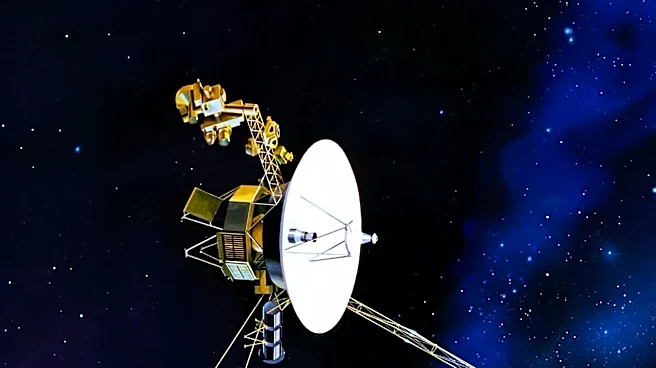
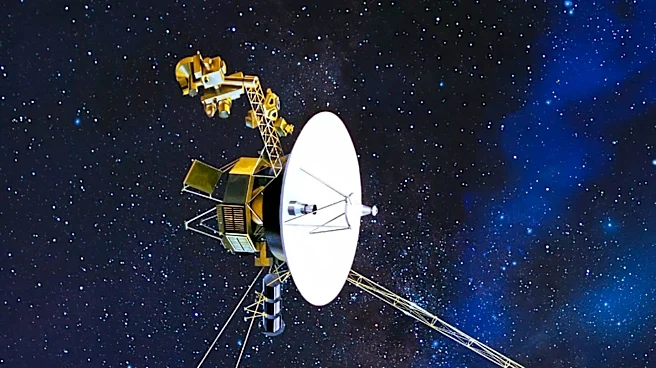
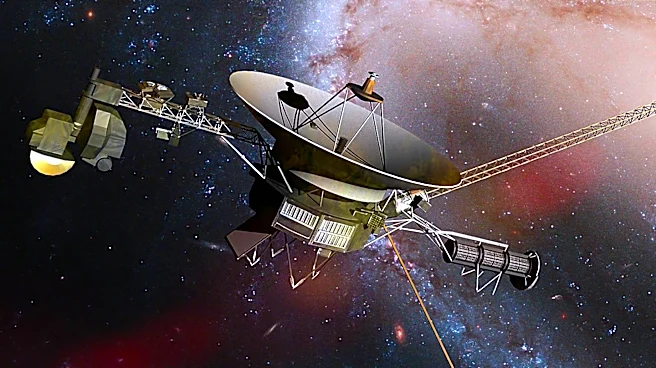
A reanalysis of data from the Voyager 2 spacecraft, the only probe to ever visit Uranus, indicates that its 1986 encounter occurred during unusually forceful solar-wind conditions. These conditions, estimated to occur only about 4% of the time, significantly
compressed the planet's dayside magnetosphere, reducing its volume by up to 78%. This finding suggests that textbook descriptions of Uranus's magnetic environment, largely based on Voyager 2's observations, may reflect an atypical state rather than its normal condition. The dynamic pressure of the solar wind, a combination of its density and speed, was significantly higher during the flyby, causing the magnetopause boundary to be much closer to the planet than average. This temporary compression could explain previously puzzling observations, such as intense electron radiation belts coexisting with a plasma-poor magnetosphere, and the apparent absence of water-group ions from Uranus's moons.
Why It's Important?
This reanalysis significantly impacts our understanding of Uranus's magnetosphere and highlights the challenges of characterizing planetary environments from single flyby missions. By revealing that Voyager 2 observed Uranus during a rare solar-wind event, scientists can now re-evaluate decades of assumptions about the planet's typical magnetic state. This has implications for future missions and research, as it underscores the need for continuous observation, ideally from an orbiter, to capture the full variability of a planet's environment. The revised understanding of Uranus's magnetosphere could also influence theories about the planet's internal dynamics and its interaction with the solar wind. Furthermore, the finding that the apparent absence of water-group ions from moons might be due to temporary plasma sweep-away removes an argument against potential geological activity on these moons, opening new avenues for research into their composition and potential for subsurface oceans.
What's Next?
The re-evaluation of Voyager 2's data will likely lead to updated models and textbook descriptions of Uranus's magnetosphere, incorporating the understanding that the 1986 observations represented an extreme, rather than typical, state. This new perspective strengthens the scientific case for a dedicated Uranus orbiter and atmospheric probe, a mission prioritized by the National Academies' planetary decadal survey. Such a mission would provide continuous, long-term observations, allowing scientists to monitor the magnetosphere's expansion and contraction, measure plasma content changes, and track radiation belts over many rotations. This would enable a more comprehensive understanding of Uranus's magnetic environment and its moons, distinguishing persistent features from transient phenomena. Until a dedicated orbiter is launched, researchers will continue to analyze existing data with this new context, potentially uncovering further insights into the unique characteristics of this ice giant.
Beyond the Headlines
This discovery extends beyond merely correcting scientific records; it serves as a profound reminder of the limitations inherent in snapshot observations in dynamic systems, whether in space or on Earth. The 'bad day' Uranus experienced during Voyager 2's visit underscores how a single data point, even from a groundbreaking mission, can lead to long-standing misinterpretations if not contextualized within the full range of possible conditions. This has broader implications for scientific methodology, emphasizing the critical role of long-term monitoring and multiple data points to establish typicality versus anomaly. Ethically, it highlights the responsibility of the scientific community to continuously re-evaluate established knowledge as new analytical tools and contextual information become available. Culturally, it reinforces the idea that scientific understanding is an evolving process, not a static collection of facts, and that even foundational observations can be subject to revision with deeper insight. This ongoing refinement of knowledge is a cornerstone of scientific progress.