
What's Happening?
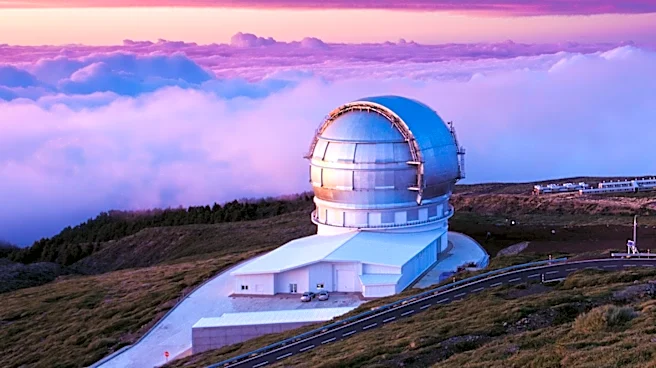
The Mauna Loa Observatory in Hawaii is projected to record a significant increase in atmospheric carbon dioxide (CO2) levels in 2027, reaching a new record of 432.2 parts per million (ppm). This forecast,
issued by the UK Met Office, anticipates an annual average increase of 3.51 ppm, which would be one of the largest annual rises ever recorded. The primary driver for this accelerated increase is a strong El Niño event, which is expected to reduce the capacity of natural carbon sinks like forests, soils, and oceans to absorb CO2. As of September 2026, the CO2 concentration stood at 426.07 ppm. The Mauna Loa Observatory has been continuously measuring CO2 levels since 1958, with initial readings around 315 ppm, highlighting a substantial long-term increase.
Why It's Important?
This projected surge in CO2 levels at Mauna Loa underscores the persistent challenge of climate change, even as global fossil fuel emissions may see slight reductions. The influence of El Niño in exacerbating CO2 accumulation highlights the complex interplay between natural climate variability and human-caused emissions. A reduced capacity of natural carbon sinks means that a larger proportion of emitted CO2 remains in the atmosphere, intensifying the greenhouse effect. This trend makes it increasingly difficult to meet international climate targets, such as limiting global warming to 1.5 degrees Celsius, as outlined by the IPCC. The continuous rise in atmospheric CO2 has long-term implications for global temperatures, sea levels, and extreme weather events, affecting various sectors from agriculture to coastal communities across the U.S. and worldwide.
What's Next?
The forecast suggests that the effects of the strong El Niño on the carbon cycle will be most pronounced in 2027. Scientists will continue to monitor the CO2 levels at the Mauna Loa Observatory, known for its critical long-term record, the Keeling Curve. The data will provide crucial insights into the combined impact of human emissions and natural climate phenomena. Policymakers and international bodies will likely face renewed pressure to implement more aggressive strategies for emissions reduction, as the current trajectory indicates a widening gap between observed CO2 increases and the levels required to achieve climate goals. The ongoing El Niño event could also lead to hotter and drier conditions in tropical regions, potentially increasing the risk of wildfires and further stressing vegetation, which would in turn diminish carbon absorption.
Beyond the Headlines
The anticipated record CO2 levels in 2027, despite potential short-term dips in fossil fuel emissions, reveal a deeper systemic issue: the cumulative effect of historical and ongoing emissions. The 'bathtub' analogy, where emissions are the faucet and natural sinks are the drain, illustrates that even a slight reduction in the faucet's flow doesn't prevent the tub from filling if the drain is also partially blocked or insufficient. The long atmospheric lifetime of CO2 means that today's emissions will impact the climate for centuries. This situation raises ethical questions about intergenerational equity and the responsibility of current generations to mitigate long-term environmental burdens. It also highlights the need for a holistic approach to climate action, addressing not only emission reductions but also the protection and enhancement of natural carbon sinks, which are increasingly vulnerable to climate change itself.