





What's Happening?
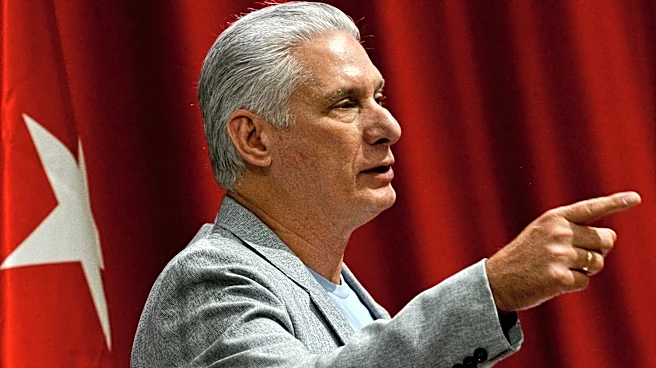
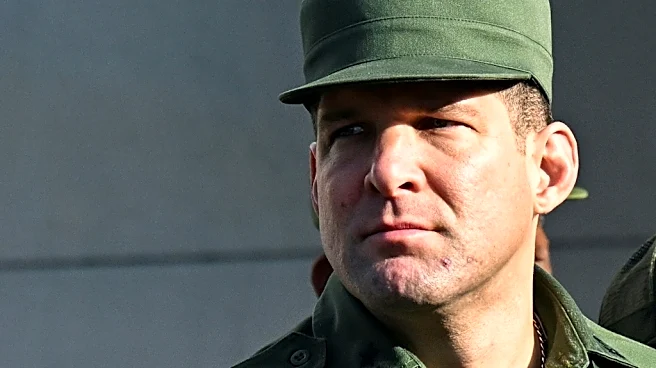
Cuban President Miguel Díaz-Canel has declared he will not resign under pressure from the United States during ongoing diplomatic discussions. These talks aim to explore future relations and potential economic ties between the two nations. Díaz-Canel,
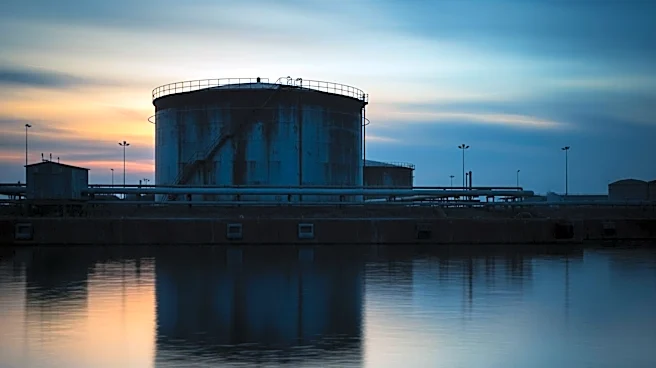
who was selected by former leader Raúl Castro, remains committed to Cuba's communist principles. His comments were made during an interview with NBC's Meet the Press, where he emphasized that Cuban leadership is not subject to U.S. mandates. The discussions occur against a backdrop of U.S. economic pressure on Cuba, including a virtual oil embargo that has led to energy shortages on the island.
Why It's Important?
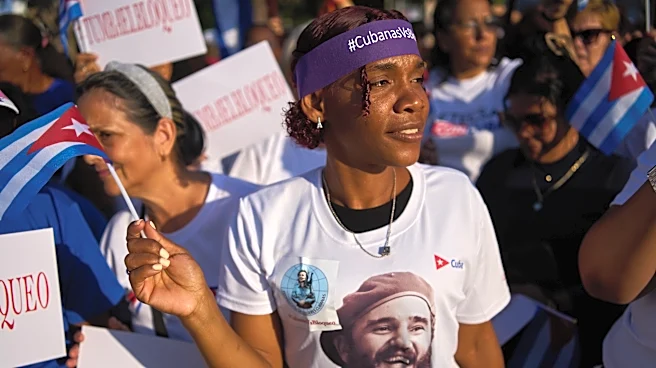
The stance taken by Díaz-Canel highlights the enduring tension between the U.S. and Cuba, a relationship historically fraught with political and economic challenges. The U.S. aims to leverage its economic influence to encourage changes in Cuba's governance, while Cuba seeks to maintain its sovereignty and political system. The outcome of these talks could significantly impact U.S.-Cuba relations, potentially affecting trade, travel, and regional stability. The situation also underscores the broader geopolitical dynamics in the Caribbean and Latin America, where U.S. influence is often contested.
What's Next?
Future negotiations between the U.S. and Cuba will likely continue, with both sides seeking to balance their interests. The U.S. may increase economic pressure to achieve its objectives, while Cuba may look for support from other international partners to counteract U.S. influence. The resolution of these talks could lead to changes in economic policies and bilateral agreements, affecting industries such as tourism and agriculture. Observers will be watching for any shifts in U.S. policy towards Cuba, which could have broader implications for regional diplomacy.