



What's Happening?
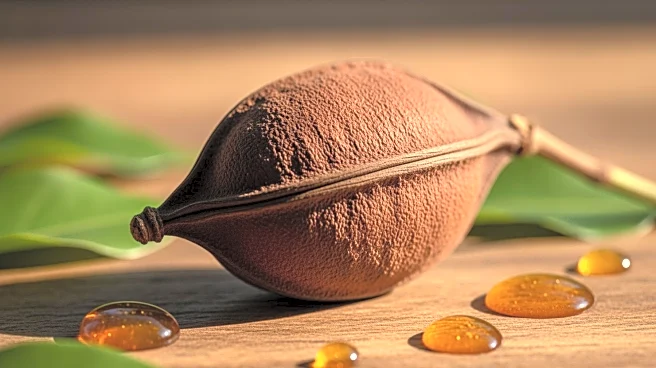
The Hymenaea courbaril tree, native to tropical regions from southern Mexico to the Amazon basin, is being studied for its potential in food and medicine. Researchers, led by Luz María Alzate Tamayo from the Lasallian University Corporation in Colombia,
are exploring how this tree can provide safe, natural ingredients for the food industry. The tree's pods contain a floury pulp rich in fiber and antioxidants, which can be milled into flour for various food products. This pulp is considered a functional food, offering health benefits beyond basic nutrition. Additionally, the tree's seed gum can stabilize ice creams and dairy desserts, potentially reducing fat and sugar content while maintaining texture. The tree also shows promise in medicine, with studies indicating its extracts have antimicrobial and antioxidant properties.
Why It's Important?
The exploration of Hymenaea courbaril as a source of food and medicinal products could have significant implications for the food industry and public health. The tree's pulp flour could enhance dietary fiber intake without added sugars or synthetic additives, aligning with consumer demand for healthier food options. Its seed gum's ability to stabilize food products could lead to innovations in low-fat and low-sugar desserts, appealing to health-conscious consumers. Medically, the tree's extracts showing antimicrobial and antioxidant properties could lead to new treatments for infections and chronic conditions. This research highlights the potential for sustainable and health-focused products derived from natural sources, which could benefit both consumers and the environment.
What's Next?
Further research and development are needed to fully realize the potential of Hymenaea courbaril in food and medicine. Food companies may explore incorporating the tree's pulp flour and seed gum into their products, potentially leading to new product lines. In medicine, more extensive clinical trials are necessary to confirm the health benefits observed in preliminary studies. Regulatory approval will also be required for any new food or medicinal products derived from the tree. As research progresses, collaborations between scientists, food manufacturers, and healthcare providers could accelerate the development and commercialization of these innovations.
Beyond the Headlines
The study of Hymenaea courbaril underscores the importance of biodiversity and traditional knowledge in modern science. Indigenous communities have long utilized this tree for food and medicinal purposes, and their practices are now being validated by scientific research. This highlights the value of preserving traditional knowledge and ecosystems, as they may hold solutions to contemporary challenges in health and nutrition. Additionally, the tree's potential to provide sustainable and health-promoting products aligns with global efforts to address climate change and promote environmental sustainability.