



What's Happening?
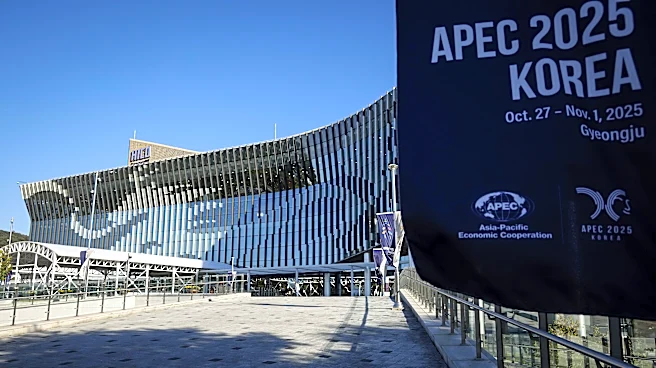
Mexican President Claudia Sheinbaum is scheduled to travel to Shenzhen, China, to participate in the Asia-Pacific Economic Cooperation (APEC) summit, which will take place on November 18 and 19. President Sheinbaum will be accompanied by members of her
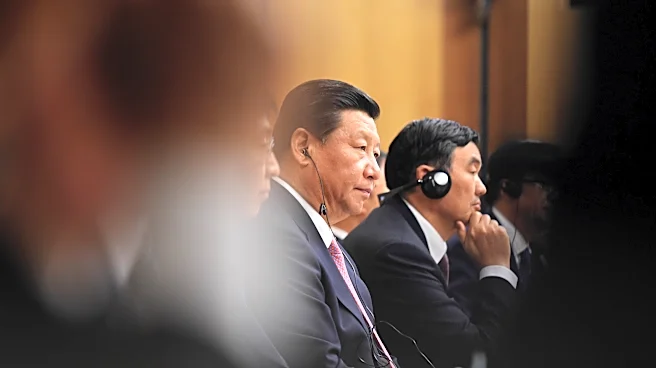
cabinet, indicating the importance Mexico places on its engagement with the Asia-Pacific region. Her itinerary includes departing for China three days prior to the summit and returning to Mexico a day after its conclusion. As a member of APEC, Mexico's participation in the summit is a regular diplomatic engagement. President Sheinbaum has also expressed her intention to seek a meeting with Chinese President Xi Jinping during her visit, highlighting a desire for high-level bilateral discussions amidst the broader APEC agenda.
Why It's Important?
President Sheinbaum's attendance at the APEC summit is significant for Mexico's international relations and economic strategy. Her participation underscores Mexico's commitment to multilateralism and its interest in strengthening ties with Asia-Pacific economies, which are crucial for trade and investment. A potential meeting with President Xi Jinping could open avenues for enhanced bilateral cooperation between Mexico and China, particularly in areas of trade, technology, and infrastructure. This engagement is especially relevant as global supply chains are undergoing adjustments and trade tensions persist, making it vital for Mexico to diversify its economic partnerships. For the U.S., Mexico's deepening ties with China, while a sovereign decision, could have implications for regional trade dynamics and geopolitical balances, particularly within the context of North American economic integration.
What's Next?
President Sheinbaum's immediate next steps involve her travel to Shenzhen and participation in the APEC Economic Leaders’ Meeting. The focus will be on her engagements during the summit, including any bilateral meetings she secures, particularly with President Xi Jinping. The outcomes of these discussions could lead to new agreements or strengthened cooperation between Mexico and China. Domestically, her absence during the Mexican Revolution celebration highlights the priority given to this international engagement. The specific details of her cabinet members accompanying her suggest a targeted approach to discussions on various sectors. The summit's broader agenda on trade, artificial intelligence, and economic resilience will also shape Mexico's future policies and international collaborations.
Beyond the Headlines
President Sheinbaum's visit to the APEC summit and her pursuit of a meeting with President Xi Jinping carry deeper implications for Mexico's foreign policy and its position in the evolving global order. It signals a proactive approach by Mexico to assert its presence on the international stage and to forge stronger economic and political alliances beyond its traditional partners. This move could be interpreted as part of a broader strategy to enhance Mexico's economic resilience by diversifying its trade relationships and reducing over-reliance on any single market. For the U.S., this development underscores the complex and interconnected nature of international relations, where allies may pursue independent foreign policy objectives that could subtly shift regional dynamics. It also highlights the growing influence of China in Latin America and the need for the U.S. to continually reassess its engagement strategies in the region.