

What's Happening?
Kathleen Martínez, a lawyer-turned-archaeologist, is challenging the long-held belief that Cleopatra's tomb is submerged beneath the waters of Alexandria. For two decades, Martínez has been excavating at Taposiris Magna, a coastal temple located 30 miles
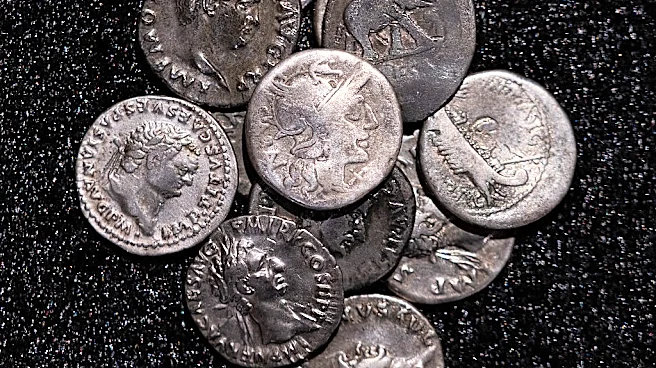
west of Alexandria, convinced that Cleopatra strategically hid her final resting place there. Historical accounts, primarily from Roman sources like Plutarch's 'Life of Antony,' suggest Cleopatra and Mark Antony were buried together in a mausoleum in Alexandria, a city now largely underwater due to earthquakes, tsunamis, and rising sea levels. Martínez's theory posits that Cleopatra, known for her intelligence, would have outsmarted the Romans by choosing a secret burial site. Her team began excavations in 2005 and has since uncovered artifacts such as coins bearing Cleopatra's image, a foundation plate dedicated to the goddess Isis (with whom Cleopatra associated herself), and a 4,300-foot-long tunnel leading to a sunken port. This tunnel, an exact replica of Greece's Tunnel of Eupalinos, suggests an elaborate burial plan, according to Martínez, where Cleopatra's mummified body could have been transported to Taposiris Magna.
Why It's Important?
The potential discovery of Cleopatra's tomb at Taposiris Magna would be a monumental archaeological find, capable of rewriting significant portions of ancient history. The current understanding of Cleopatra's death and burial relies heavily on Roman accounts, which are often biased, portraying her as a manipulative figure. Finding her tomb could provide an Egyptian perspective, offering new insights into her life, reign, and the circumstances surrounding her death. Such a discovery would also shed light on ancient Egyptian burial practices and the strategic thinking of its rulers. Beyond historical revision, the contents of the tomb, particularly Cleopatra's body, could allow scientists to reconstruct her physical appearance, a subject of much historical debate, and potentially determine the exact cause of her death. This would have a profound impact on Egyptology and classical studies, attracting global attention and potentially boosting cultural tourism to Egypt. Conversely, if Martínez's theory proves incorrect, it reinforces the existing historical consensus and highlights the challenges of archaeological interpretation, especially when dealing with figures whose narratives have been heavily influenced by their adversaries.
What's Next?
Kathleen Martínez continues her excavation efforts at Taposiris Magna, steadfast in her belief that Cleopatra's tomb lies within the site. The ongoing work will likely involve further exploration of the recently discovered tunnel and the sunken port, as well as other areas within the temple complex. Future discoveries will need to be rigorously documented and, ideally, subjected to peer-reviewed studies and excavation reports to gain wider acceptance within the archaeological community. Currently, many experts, including Jane Draycott and Stephen Buckley, remain skeptical, citing the lack of peer-reviewed evidence and the historical consensus placing the tomb in Alexandria. Martínez's ability to present compelling, verifiable archaeological data will be crucial in swaying these opinions. The search for Cleopatra's tomb is a long-term endeavor, and it will require continued funding, international collaboration, and meticulous scientific work to either confirm or definitively refute Martínez's controversial theory.
Beyond the Headlines
The search for Cleopatra's tomb transcends mere archaeological discovery; it delves into the broader themes of historical narrative, gender bias, and the power of interpretation. Roman sources, which largely shape our understanding of Cleopatra, often vilified her, presenting a skewed image. Martínez's quest implicitly challenges this historical framing, suggesting a more complex and strategic figure than often portrayed. The controversy surrounding her theory also highlights the dynamics within the archaeological field, where unconventional approaches often face skepticism from established experts who prioritize traditional evidence and peer-reviewed processes. This ongoing debate underscores the importance of critical analysis of historical texts and the potential for archaeological findings to offer alternative perspectives. Furthermore, the fascination with Cleopatra's missing tomb reflects a universal human desire to uncover the secrets of the past and connect with legendary figures, demonstrating how historical mysteries continue to captivate and drive scientific and cultural exploration.