


What's Happening?
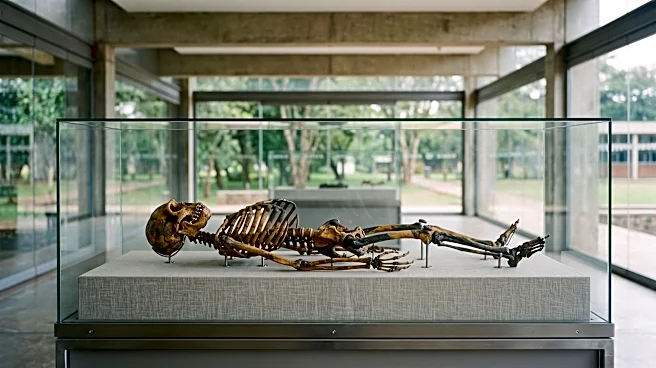
President William Ruto has revealed plans to relocate the original remains of Turkana Boy from a secure vault at the National Museums of Kenya to Uhuru Park in Nairobi for public display. This initiative aims to make the significant archaeological discovery
accessible to both local and international visitors, thereby showcasing Kenya's rich heritage and its pivotal role in human history. President Ruto made this announcement during the Third Global Parliamentary Summit Against Hunger and Malnutrition at Parliament Buildings in Nairobi. He informed visiting delegates that preparations are underway to facilitate public viewing of the remains. Turkana Boy, discovered in 1984, is an approximately 1.6-million-year-old fossilized skeleton of a young Homo erectus, considered the most complete Homo erectus skeleton ever found. Currently, the original remains are kept in a secure facility, with a replica available for public viewing.
Why It's Important?
The decision to exhibit Turkana Boy at Uhuru Park is a significant move to democratize access to a crucial piece of human history. By making these remains more accessible, Kenya aims to boost cultural tourism and educate a broader audience about human origins. This initiative could enhance Kenya's standing as the 'birthplace of humanity,' attracting researchers, tourists, and educational groups worldwide. The move also reflects a strategic effort to leverage national heritage for economic and educational benefits. It underscores the importance of preserving and presenting archaeological discoveries in a way that engages the public and fosters a deeper understanding of our shared past. The exhibition could also spark renewed interest in paleoanthropological research and conservation efforts in the region.
What's Next?
President Ruto indicated that while the exhibition might not be ready for the current delegates' visit, it would be available for public viewing upon their return. This suggests that the government will proceed with the necessary logistical and security arrangements to safely transfer and display the Turkana Boy remains. The move will likely involve collaboration between the National Museums of Kenya, the Ministry of Tourism, and other relevant government agencies. There may be public discussions and consultations regarding the best way to present such a sensitive and valuable artifact, ensuring its preservation while maximizing public engagement. The initiative is expected to be part of a broader strategy to promote Kenya's cultural and historical sites.
Beyond the Headlines
The exhibition of Turkana Boy at a public park rather than solely within a museum vault raises interesting questions about accessibility versus preservation. While increasing public access, it also necessitates robust security and environmental controls to protect the delicate fossil. This move could set a precedent for how other significant archaeological finds are presented globally, balancing scientific integrity with public education. Furthermore, by emphasizing Kenya as the 'birthplace of humanity,' the initiative taps into a powerful narrative that could foster national pride and international recognition. It also highlights the ethical considerations of displaying human remains, even ancient ones, and the importance of respectful presentation that honors their scientific and historical significance.