

What's Happening?
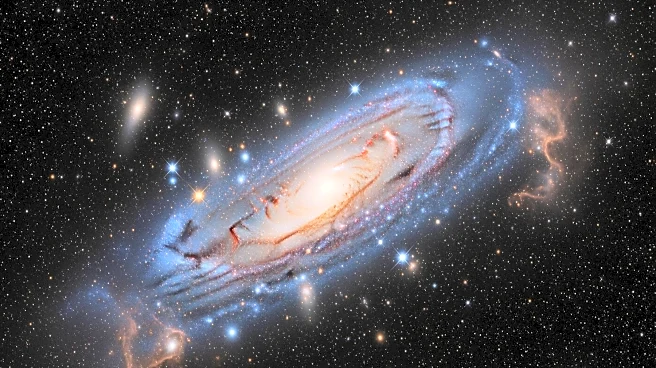
An international team of astronomers has utilized the James Webb Space Telescope (JWST) to study a nearby spiral galaxy, NGC 628, revealing insights into emerging young star clusters (eYSCs). These clusters, which are less than 100 million years old,
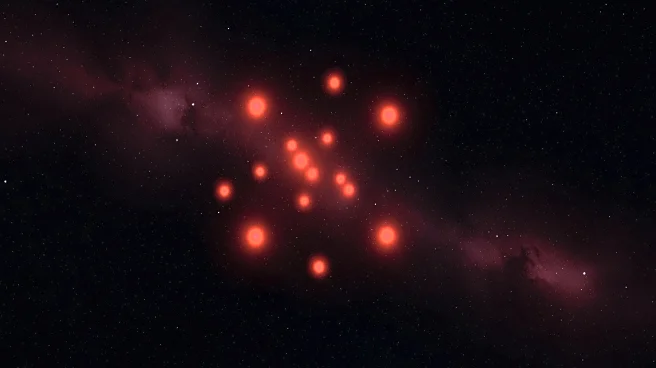
are crucial for understanding star formation and galactic dynamics. The study, led by Helena Faustino Vieira from Stockholm University, focused on the galaxy's vibrant star-forming regions. Using JWST's Near Infrared Spectrograph (NIRSpec), the team identified 14 eYSCs, still embedded in their natal clouds, and observed their impact on the surrounding interstellar medium. The findings highlight the clusters' early evolutionary stages and their role in shaping the galaxy's structure.
Why It's Important?
The study of eYSCs in NGC 628 provides valuable data on the early stages of star formation, which is essential for understanding the lifecycle of galaxies. By examining these clusters, astronomers can gain insights into the processes that govern stellar evolution and the dynamics of galactic environments. The research also underscores the capabilities of the JWST in penetrating dusty regions of space, offering a clearer view of phenomena that are otherwise invisible at optical wavelengths. This advancement in observational astronomy could lead to new discoveries about the formation and evolution of galaxies across the universe.