



What's Happening?
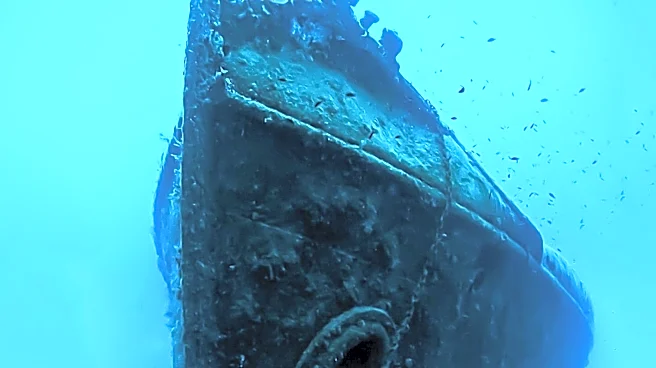
Two historic vessels, the 'Victory Chimes' and the 'PILOT,' which mysteriously sank in Brooklyn's polluted Gowanus Basin in July, are now likely to be scrapped. The 'Victory Chimes,' a U.S. National Historic Landmark and the official Windjammer of Maine,
was featured on the state's 2003 quarter. The 'PILOT,' a former research vessel for Jacques Cousteau, was on its way to becoming a National Historic Landmark. Both ships, owned by brothers Alex and Miles Pincus who convert boats into floating restaurant bars, had been moved to the Gowanus Canal inlet for repairs. Sources indicate that the cost of refloating and repairing the vessels, potentially millions of dollars, may be deemed too high by the owners, leading to their disposal. The 'Victory Chimes' is reportedly in worse condition, making repair less viable.
Why It's Important?
The potential scrapping of these historic vessels represents a significant loss of maritime heritage for both Maine and the nation. The 'Victory Chimes' holds cultural and historical importance as a symbol of Maine's seafaring tradition, while the 'PILOT' has a notable legacy in scientific exploration. Their demise highlights the challenges of preserving historic ships, particularly the immense financial and logistical burdens associated with their maintenance and restoration. This situation also raises questions about the responsibilities of owners of historic properties and the effectiveness of current preservation mechanisms. The incident underscores the vulnerability of such artifacts to unforeseen events and the economic realities that often dictate their fate, potentially leading to a re-evaluation of how historically significant vessels are protected and managed.
What's Next?
The owners, Alex and Miles Pincus, are currently working with insurers, marine salvage experts, and surveyors to determine the best path forward. Three scenarios are being considered: refloating and repairing the vessels, refloating them for total disposal, or disassembling them at the seafloor. However, sources suggest that disposal is the most probable outcome due to the high costs involved, with refloating alone estimated at a minimum of $500,000. The decision will likely involve complex negotiations with insurance companies, as insurance may not cover damages without a concrete plan for the ships post-refloating. This situation will continue to be monitored by maritime historians, preservationists, and the public, especially those in Maine, who have a strong connection to the 'Victory Chimes.'
Beyond the Headlines
The sinking and potential scrapping of these vessels illuminate broader themes concerning the intersection of history, commerce, and environmental challenges. The transformation of historic ships into commercial ventures, such as floating bars, reflects a modern approach to preservation that seeks to make heritage assets economically viable, yet this approach carries inherent risks. The pollution of the Gowanus Basin, where the ships sank, adds another layer of complexity, highlighting environmental concerns in urban waterways. This event also sparks a debate about the intrinsic value of historical artifacts versus their economic utility and the difficult choices that arise when these values conflict. The emotional response from Mainers, who viewed the 'Victory Chimes' as a symbol of their state, underscores the deep cultural attachment communities have to their heritage, even when faced with the practicalities of preservation.