

What's Happening?
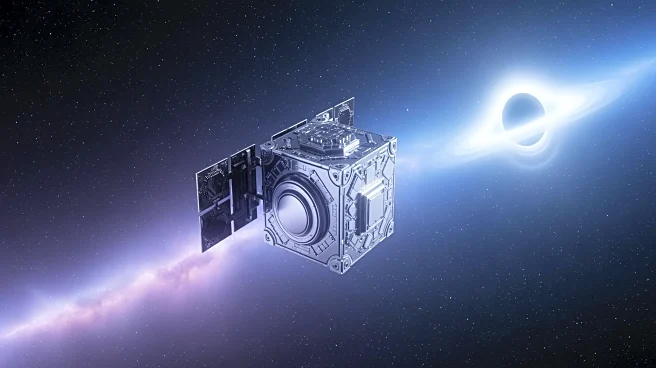
SpaceX's recent launch from Vandenberg Space Force Base included the deployment of two CubeSats, SPARCS and BlackCAT, as part of a rideshare mission. These small satellites are designed to study low-mass stars and black holes, respectively. SPARCS, developed
by Arizona State University and NASA's Jet Propulsion Laboratory, will monitor ultraviolet emissions from low-mass stars to understand their impact on surrounding space-weather environments. BlackCAT, designed by Pennsylvania State University in partnership with Los Alamos National Laboratory, will conduct a wide-field X-ray survey to detect transient events from the early universe, such as gamma-ray bursts and forming black holes.
Why It's Important?
The deployment of SPARCS and BlackCAT represents a significant advancement in the field of astrophysics, particularly in the study of low-mass stars and black holes. SPARCS aims to provide insights into the activity of low-mass stars, which are the most common yet volatile stars in our galaxy. Understanding their behavior is crucial for assessing the potential habitability of surrounding planets. BlackCAT's mission to detect gamma-ray bursts and forming black holes will complement existing X-ray missions, enhancing our understanding of the early universe. These CubeSats demonstrate the growing importance of small satellite missions in advancing space science and exploration.
What's Next?
Both SPARCS and BlackCAT will continue their respective missions in low-Earth orbit, collecting data that will contribute to our understanding of stellar and black hole phenomena. The insights gained from these missions could inform future astrophysics research and the development of new technologies for space exploration. As these CubeSats operate, they will provide valuable data that could lead to breakthroughs in our understanding of the universe's formation and the conditions necessary for life on other planets.