





What's Happening?
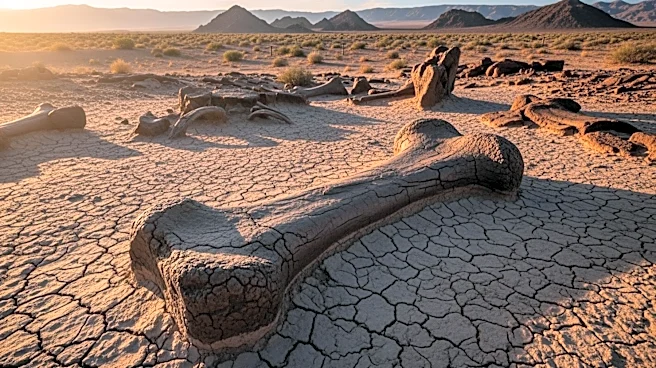
A shepherd in Patagonia, Argentina, has discovered a 20-meter-long dinosaur fossil dating back 155 million years to the Late Jurassic period. The fossil, found in the Chubut Province, includes over 30 vertebrae, ribs, and part of a pelvis, indicating
an adult animal of significant size. Named Bicharracosaurus dionidei, the dinosaur exhibits a mix of traits from different sauropod families, making its classification challenging. Researchers have placed it within the Brachiosauridae group, noting similarities to both Giraffatitan and Diplodocus. This discovery is significant as it provides new insights into the evolution of giant herbivores across ancient continents.
Why It's Important?
The discovery of Bicharracosaurus dionidei is crucial for understanding the evolutionary history of sauropods, particularly in the Southern Hemisphere. Until now, most knowledge about these dinosaurs came from fossils found in North America and other northern regions. This find from Patagonia, a region increasingly recognized as a fossil hotspot, allows scientists to compare dinosaurs across different continents, enhancing the understanding of their global distribution and evolution. The unique combination of traits in Bicharracosaurus dionidei challenges existing classifications and could lead to a reevaluation of sauropod evolution.
What's Next?
The fossil is currently housed at the Museo Paleontológico Egidio Feruglio in Trelew, Argentina. Researchers will continue to study the remains to further understand the evolutionary significance of Bicharracosaurus dionidei. This discovery may prompt additional paleontological expeditions in Patagonia, potentially leading to more groundbreaking finds. The scientific community will likely engage in discussions and debates regarding the classification and evolutionary implications of this new species.
Beyond the Headlines
The discovery highlights the importance of local contributions to paleontology, as the initial find was made by a shepherd, Dionide Mesa, on his farm. This underscores the potential for significant scientific discoveries in everyday settings and the value of local knowledge in scientific research. The naming of the species in honor of Mesa reflects the collaborative nature of paleontological research and the role of local communities in advancing scientific knowledge.