


What's Happening?
Researchers at NYU Langone Health have identified the high-level visual cortex (HLVC) as the brain region responsible for 'one-shot learning,' a process where a single exposure to an image significantly enhances recognition ability. This discovery, published
in Nature Communications, highlights how stored images, or 'priors,' are accessed in the HLVC to facilitate this rapid learning. The study involved using functional magnetic resonance imaging (fMRI) and intracranial electroencephalography (EEG) to track brain activity during image recognition tasks. The findings suggest that the HLVC plays a crucial role in accessing these priors, which are essential for recognizing blurred or partially obscured images. This research also connects to conditions like schizophrenia and Parkinson's disease, where abnormal one-shot learning can lead to hallucinations.
Why It's Important?
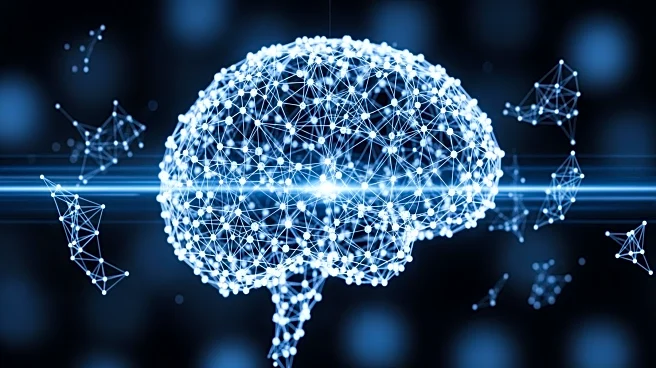
The identification of the HLVC as a key player in one-shot learning has significant implications for both neuroscience and artificial intelligence (AI). Understanding this brain mechanism could lead to advancements in AI models that mimic human-like perceptual learning, allowing them to classify new objects or learn tasks with minimal training data. This convergence of computational neuroscience and AI could revolutionize how machines learn and process information, potentially leading to more efficient and adaptable AI systems. Additionally, the study's insights into neurological disorders could inform new therapeutic approaches for conditions where perception is impaired.
What's Next?
Following this discovery, researchers are likely to explore further the connections between the HLVC and other brain regions involved in perception and learning. There may also be increased efforts to develop AI models that incorporate these findings, potentially leading to breakthroughs in machine learning technologies. In the medical field, understanding the role of priors in hallucinations could lead to new treatments for schizophrenia and Parkinson's disease. The study's authors are also investigating the broader implications of these findings for understanding the 'aha moment' in cognitive processes.
Beyond the Headlines
This research not only advances our understanding of brain function but also raises ethical and philosophical questions about the nature of learning and perception. As AI systems become more human-like in their learning capabilities, society will need to address issues related to machine autonomy and decision-making. Furthermore, the potential for AI to replicate human cognitive processes could lead to debates about the role of technology in human life and the boundaries between human and machine intelligence.