

What's Happening?
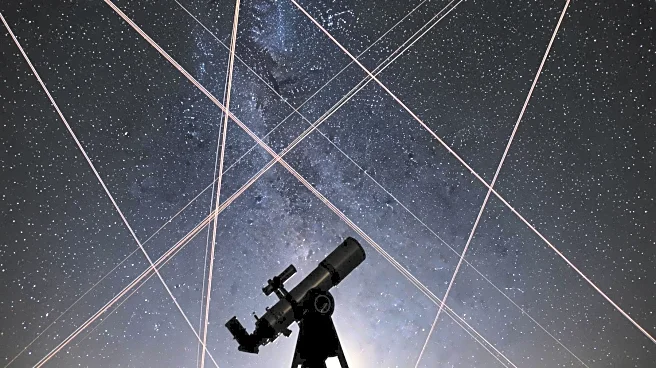
NASA has released a report highlighting the potential impact of satellite constellations on astronomical imaging. The report, published in Nature, predicts that up to 40% of images captured by the Hubble Space Telescope could be affected by satellite streaks.
More concerning is the prediction that three other space telescopes could experience a 96% contamination rate, severely limiting their effectiveness. The proliferation of satellites in low Earth orbit (LEO), driven by companies like SpaceX and others, is cited as a major factor. SpaceX's Falcon 9 rocket has significantly reduced the cost of launching satellites, leading to a surge in satellite deployments. The report also notes that ground-based observatories, such as the Vera C. Rubin Observatory, are at risk, with up to 80% of its images potentially compromised if satellite numbers exceed 50,000.
Why It's Important?
The findings underscore a growing challenge for the field of astronomy, as the increasing number of satellites in orbit threatens to compromise the quality of astronomical data. This could hinder scientific research and discovery, as clear images of space are crucial for understanding the universe. The contamination of images could delay or even prevent significant astronomical discoveries, impacting both scientific progress and public interest in space exploration. The issue also raises questions about the balance between commercial satellite deployment and the preservation of space as a resource for scientific inquiry.
What's Next?
The report suggests several potential solutions, such as applying Vantablack paint to satellites to reduce their visibility in telescope images. However, these solutions are not yet implemented, and public pressure may be necessary to drive action. The situation calls for international cooperation and regulation to manage satellite deployments and mitigate their impact on astronomy. The scientific community may also need to develop new technologies or methods to filter out satellite interference in images.