
What's Happening?
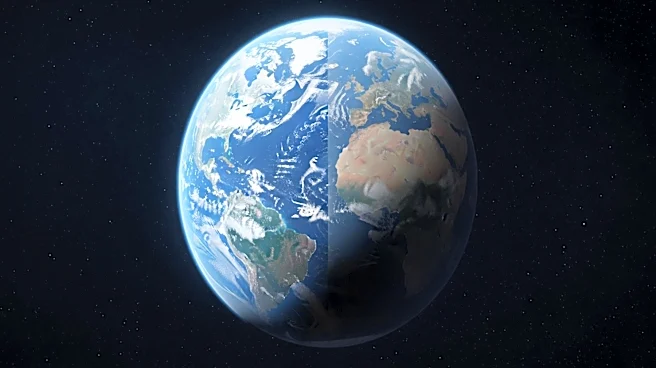
A recent study conducted by scientists from the University of Oslo, published in Geophysical Research Letters, has revealed that Earth's hemispheres have been cooling at different rates over the past 400
million years. The research utilized computer models to reconstruct Earth's thermal history, dividing the planet into the African and Pacific hemispheres. The study found that the Pacific hemisphere has cooled approximately 50 Kelvin more than the African hemisphere. This cooling disparity is attributed to the mechanics of plate tectonics and the efficiency of heat loss through the oceanic lithosphere. The Pacific Ocean, with its extensive seafloor, acts as a significant dissipator of Earth's internal heat, while continental landmasses insulate and trap heat. The study also noted that despite the Pacific hemisphere's greater cooling, it has exhibited higher plate velocities, suggesting a complex interplay of geological factors.
Why It's Important?
The findings of this study are significant as they provide a deeper understanding of Earth's thermal evolution and the role of oceanic and continental structures in heat dissipation. This research highlights the importance of the oceanic lithosphere in regulating Earth's internal heat, which has implications for understanding the planet's long-term geological and magnetic stability. The study's insights into the uneven cooling of Earth's hemispheres could inform future research on tectonic activity and its impact on global geological processes. Additionally, understanding these thermal dynamics is crucial for predicting Earth's future geological state and its potential to resemble geologically inactive planets like Mars.
What's Next?
Further research is needed to explore the underlying causes of the Pacific hemisphere's higher plate velocities despite its greater cooling. Scientists may investigate historical landmass configurations and other geological factors that could have influenced the current thermal and tectonic dynamics. This study opens avenues for more detailed investigations into the interactions between Earth's internal heat, tectonic activity, and surface geological features. Such research could enhance predictive models of Earth's geological future and contribute to broader planetary science studies.
Beyond the Headlines
The study's findings also raise questions about the long-term implications of Earth's cooling on its magnetic field and atmospheric stability. As Earth's internal heat continues to dissipate, understanding the potential impacts on the planet's magnetic field, which protects the atmosphere from solar winds, becomes increasingly important. The research underscores the need for interdisciplinary studies that integrate geological, atmospheric, and magnetic data to provide a comprehensive picture of Earth's evolving state.