








What's Happening?
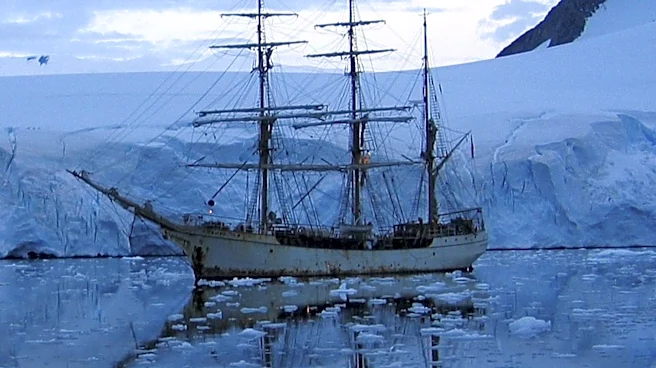
A significant expedition has been launched by the Royal Canadian Geographical Society (RCGS) and the Woods Hole Oceanographic Institution (WHOI) to survey the wrecks of two historic Antarctic exploration ships, Quest and Terra Nova. These ships were integral
to the expeditions led by Sir Ernest Shackleton and Captain Robert Falcon Scott in the early 20th century. The Terra Nova, after its initial expedition, was repurposed for whaling and later used during World War II before sinking off the coast of Greenland in 1943. Its wreckage was rediscovered in 2012. Quest, which outlived Terra Nova, was involved in various missions, including a rescue operation and military service, before sinking in 1962. The current expedition aims to conduct the first comprehensive visual survey of these ships using advanced imaging technology to create digital recreations for further study.
Why It's Important?
This expedition is crucial for historical and scientific communities as it aims to preserve and document significant artifacts from early Antarctic exploration. By using cutting-edge technology, researchers can create detailed digital models of the shipwrecks, providing insights into early 20th-century maritime engineering and the harsh conditions faced by explorers. The project also highlights the collaboration between Canadian and American institutions, showcasing the importance of international cooperation in scientific endeavors. The findings could inspire future generations of explorers and historians by bringing to life the stories of Shackleton and Scott, whose leadership and bravery have been celebrated for decades.
What's Next?
The expedition will utilize the research vessel Atlantis, along with submersibles like Alvin, to conduct detailed surveys of the wrecks. The use of high-definition cameras and photogrammetric technology will allow for unprecedented documentation of the sites. The results of this survey are expected to be shared with the public, potentially through exhibitions or digital platforms, to educate and inspire interest in polar exploration history. The success of this mission could lead to further collaborative projects between international research institutions, focusing on other historical shipwrecks or unexplored maritime sites.